LEW on Vulnerability, Self-Belief, and the Power of Reinvention
LEW’s story is, at its core, a study in fearless self-redefinition.
Long before she stepped into a bold new chapter of avant-pop, the Massachusetts-born singer-songwriter was already carving out space for herself in Nashville under her given name, Lauren Weintraub. Quickly drawing attention for her sharp writing and emotional candor, she released country-leaning songs that pushed at the edges of the genre. But as the industry narrowed her into lanes that didn’t feel fully her own, Weintraub began to sense that she was outgrowing the version of herself that she had worked so hard to build.
In 2024, she made that internal shift public. Reborn as LEW, she shed the stylistic expectations that once defined her and embraced an identity that was rooted in creative autonomy, duality, and pop ambition.
Her latest EP, TOO SEXY TO BE SAD, reveals an artist unafraid of contradiction: soft and sharp, vulnerable and self-assured, introspective yet gloriously uncontained. Tracks including “WAIT ON ME” and the infectiously compelling “PHANTOM LIMB” mark a distinct break from her Nashville era, swapping the tidy narratives of country songwriting for something messier, more electric, and unmistakably her own.
Still early in her reinvention, LEW’s legacy is still being written, but its central thesis is clear: reinvention isn't a detour; it's the destination.
KP: It’s very rare that I start by diving straight into a new release, but I love “Phantom Limb” so much. I am, admittedly, a pop girl at heart — deep, deep down inside. [Laughs] Its production is incredible — it feels unique and fresh in a way that so much pop music is lacking today. So to kick things off, could you tell us a little bit about the writing and production behind it? I hope that you love it as much as I do! [Laughs]
LEW: Oh my god, of course. I do love it as much as you do! “Phantom Limb” was actually the final song written for this whole project, and I had this feeling that there was still one more self-reflective, quietly vulnerable track that hadn’t been born yet — one of those “Oh… maybe I am a little sad today” realizations. I was lucky enough to be in the room with two of my favorite collaborators, Ricky Manning and Mike Robinson. I told them I wanted to go somewhere sonically I’d never gone before, and Mike cooked up that insane production. Ricky is basically a melody god, so it became this perfect little alchemy of the three of us. The song itself is about being years out from someone and fully convincing yourself that you never think about them anymore… while absolutely still thinking about them. It’s that whole denial spiral of, “Even if I see you everywhere like a ghost, that doesn’t mean I care.” Which… obviously means you care. That tension is the heart of the song. And I just love how it sounds. I’d never really used my voice in that lighter, cooler way before — it unlocked a new tone for me. The beat, the world it creates… I’m obsessed. It’s one of my favorites.
KP: It is so cool. I listen to it all the time!
To go all the way back, you grew up in Boston. How did your upbringing and early life shape your musical influences? What first made you want to write songs and perform?
LEW: Yes, I miss Boston all the time. And a crazy fun fact about me — I’m a triplet. That’s always my go-to fun fact.
KP: Oh, wow! One of my best friends from college is a triplet! You guys are a rare breed. [Laughs]
LEW: Growing up, I wanted to do everything that my siblings did, so I tried everything: tee-ball, baseball, soccer, karate. Meanwhile baseballs are flying past my face in the outfield, and my dad is like, “Oh my god, she’s gonna get whacked.” I had zero hand-eye coordination.
One day I was sitting in the lobby of my brother’s dance studio, and I just remember thinking, Wait, I want to do that instead. So I started dancing, then singing, and then I fell deeply into theater. I was definitely a theater kid, which probably isn’t surprising at all. I think all those years of playing characters and singing other people’s songs eventually made me want to express my own. I did theater for about ten years — an off-Broadway show, some commercials — and then when I was around 15 or 16, I had this moment of wanting to tell my own story. Which was terrifying, because it felt like starting over with no rules, but I wanted to try. That’s when I started writing songs.
Growing up, I had this lime-green boombox in my room, and I was obsessed with Katy Perry, Pink, and Lady Gaga — all of these fierce, feminine pop icons. And when I started writing, I fell in love with the work of writers like Lori McKenna, Carole King, Bruce Springsteen, Bob Dylan — deep writers. I feel like my artistry now lives at the intersection of those two worlds: the heart and craft of classic songwriting mixed with the badass, bold pop-girl power that I grew up idolizing.
KP: They were mine as well! At least in pop. [Pink’s] Missundaztood came out when I was seven; it was the first album I ever bought with my own money, and it quite literally changed my life. I honestly don’t know if I’d be the woman I am today if I didn’t have Pink to look up to as a rejected, highly misunderstood kid.
And as for Gaga — being a New York Italian, all-girls Catholic school survivor — that love comes very naturally to me. [Laughs] Born This Way is her magnum opus, and I’ll never forget the first time I heard “Heavy Metal Lover,” “Government Hooker,” or — even earlier — “So Happy I Could Die.” Clearly, we’re on the same wavelength.
Which of their tracks are your favorites, and how do you feel their music shaped both your individuality and your artistry?
LEW: Oh my god — my mothers. My true mothers. We are absolutely on the same wavelength. Picking favorite tracks is impossible, but from Pink, “Just Like a Pill” was the one for me.
KP: Me too! It still is. That and “Don’t Let Me Get Me,” of course! I also loved “Trouble” as a kid. And as an adult. [Laughs] And “Feel Good Time!”
LEW: And “Fuckin’ Perfect” and “So What.” Those songs shaped me. I remember being a kid with my little iPod Touch, just staring at the cover art for “Fuckin Perfect” for way too long. She looked so feminine and masculine at the same time — confident, powerful, unbothered. I remember thinking, I want to feel that powerful. I want to be that fearless. She is such a badass.
KP: The most badass. That was me with the cover for Try This! It’s still so cool; I love it.
LEW: And with Gaga… it’s honestly deeply impossible to choose. I loved ARTPOP, but “Born This Way” is the song that changed my life forever. Like, forever forever. I would go on YouTube and watch every performance, every interview, every behind-the-scenes clip — I was obsessed with how she carried herself and how limitless her creativity was. There was no ceiling on anything that she did, and as a kid who definitely did not feel cool in school — someone who felt like a bit of an outcast — seeing her break every rule felt like oxygen.
Having women like that to look up to was everything. They made me feel like there was space for someone like me, someone who didn’t fit neatly into one box.
KP: I definitely relate.
In speaking about the video for “Too Sexy To Be Sad,” you said, “That’s the spirit of the video: owning your story, your desires, your softness, and your strength all at once. What if being sad isn’t a weakness? What if your vulnerability is actually your superpower? At my core, I’ve always been all about promoting power in vulnerability — that’s how we level up human connection.” I love that sentiment so much, and I went on a very similar personal journey years ago.
Can you expand on what “power in vulnerability” means to you now, especially in this new era of your music? How does that philosophy shape the way you write, perform, and present yourself?
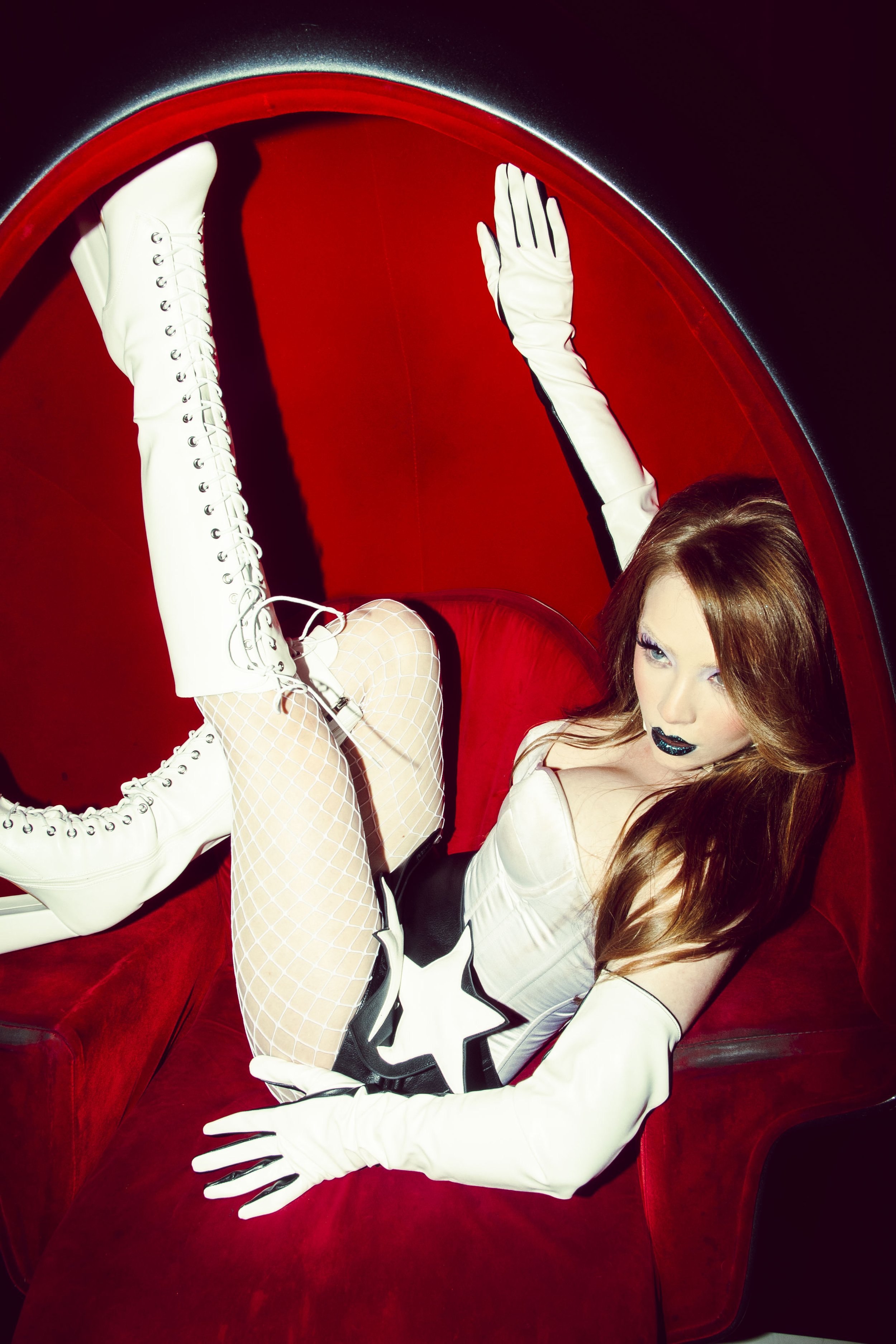
“I’ve realized that evolving is not only good — it’s necessary. You shouldn’t be the same person that you were a year ago… honestly, you shouldn’t even be the same person that you were last week.”
LEW: I love that you went on a similar journey a few years ago because, honestly, I think it’s one of the most impactful journeys that anyone can go on.
Power and vulnerability basically mean everything to me. A year or two into officially releasing music, I read Start With Why by Simon Sinek, and it completely changed my life. It forced me to sit with the question, “What is the actual mission here?” Because my goal isn’t just to rack up streams. That’s cool, but it’s not the thing that makes me feel aligned with the universe. The moment I feel that alignment most intensely is when I’m onstage making eye contact with someone and we’re sharing an emotion that maybe neither of us fully admitted before. That feeling of being seen, or helping someone else feel seen — that’s the whole point for me.
I realized that every powerful, transformative, uncomfortable, or beautiful thing in my life has come from vulnerability. And we tend to define vulnerability really narrowly, but truly, it’s just being exposed to the possibility of not knowing the outcome. It’s not knowing how something will be received — whether that’s what you say, what you wear, or how you move through the world. Vulnerability isn’t just emotional; it’s a posture. Once I understood that, I decided that my entire artist project had to be rooted in vulnerability in every sense of the word. And the older I get, the more I believe that in a society drifting away from human connection, the antidote is… human connection. And the only proven way to get there is through vulnerability. It literally fosters connection biologically, so it shapes everything that I do.
I get really excited thinking about the future — about creating events and spaces built around that idea. I want my concerts to feel like the ’80s before phones existed, where you could talk to the person next to you, meet your partner, meet your new best friend, and have this spontaneous moment that shifts your entire life. It’s the only way we get back on the right path — not just as an artist community but as humans. Realignment is always going to require vulnerability.
KP: Definitely. But wielding vulnerability as a superpower can be revealing. How do you process moments of self-doubt or insecurity, especially when they collide with the pressures of public scrutiny?
LEW: Honestly, vulnerability being my superpower doesn’t mean that I’m immune to self-doubt. If anything, it means that I’m constantly bumping into it. When you’re choosing to be open about your feelings — and doing it publicly — there are definitely moments where it’s like, Oh god, did I get it wrong? Are people going to misunderstand me? For me, the way that I process those moments is by zooming out and remembering why I’m doing any of this in the first place. If my whole artistic mission is about human connection, then of course there are going to be uncomfortable days — that’s literally the price of honesty. And I’ve learned that the discomfort doesn’t mean that the vulnerability was a mistake; it usually means that I hit on something real.
I also have to give myself private space to come back to center. Sometimes that looks like journaling, or calling my mom, or going on a walk without my phone, or reminding myself that I don’t actually owe the entire world constant access to every part of me.
Vulnerability isn’t oversharing — it’s choosing to show the parts that matter with intention. I try to ground myself in the fact that the people who resonate with my work don’t expect perfection — they expect honesty. They expect humanity. And every time I’ve taken a risk and been vulnerable anyway, someone eventually says, “Thank you, I needed that.” That’s usually enough to pull me back into alignment. Like, Okay, this is bigger than my fear. This is why I’m here.
KP: You’ve made a significant career shift recently, moving from a more country-infused sound to something decidedly pop-leaning. Looking back, was there a pivotal moment of self-realization that helped shape both the person and the artist you are today?
LEW: Yes. I remember getting back from a festival in the country world, watching all of the videos that people had posted, and having this very clear moment of, Damn… I don’t know what my next chapter is, but I know that it’s not this. It wasn’t that I felt like I couldn’t be my authentic self in country. Honestly, I think that it would’ve been pretty badass to bring some wild, unexpected energy into that space. But when I stepped back, I had to be really honest with myself: I didn’t grow up on this genre. I loved parts of it, but it wasn’t the music that actually lived in my bones. I’d play country shows and then go home and listen to rock and R&B and pop. So I had to ask myself, Is this what I want now… or is this what I wanted five years ago? And realizing it might be the latter was really fucking hard. Starting over was hard. Reintroducing myself to the world was hard. And I still have days where I’m like, Okay, this is going to be a tough road. But every time I step onstage with this new music as LEW, it feels more authentic than I’ve ever felt in my life. Those are the moments where I’m like, Yeah. I’m on the right path. This is divine. This was always going to happen. And if I hadn’t made the shift when I did, I think I would’ve just delayed the inevitable. So even though it’s been scary, I’m really grateful that I followed that instinct.
KP: It was definitely the right move.
I’ve spoken to so many artists recently who’ve left their labels in search of the creative freedom that comes with being independent. You recently made that same shift. What ultimately pushed you to take that step, how did you find that sense of inner strength and self-confidence, and how has being independent changed the way you make music and move through the industry?
LEW: Being independent has completely changed not only the way I make music and navigate the industry — it has honestly changed my life.
“I’ve never felt fully feminine or fully masculine. I’ve never felt fully soft or fully tough. I exist in that gray area where both things are always true at once, and instead of trying to force myself into one clean category, I finally decided to build a world that celebrates the messiness of that.”
2025 was my first year having a label but no management, no agent, no publisher… no team except me, my financial advisor, and my attorney (go off, financial advisor and attorney <3). That’s it. And stepping into that reality shifted everything for me. For the first time, I started acting like the boss. I’ve always known that I’m the CEO of myself, but this was the year that I truly embodied it. It’s wild comparing who I was at the top of 2025 to who I am now. I don’t think that we ever fully know ourselves — we’re always evolving — but we can know what we want in a moment. And I have never known what I want more clearly than I do right now.
A lot of that came from making every decision myself. Not having someone in my ear at every turn saying, “What if you did this instead?” I think those voices can be valuable in certain contexts, but when you’re too young and that’s the only input you’re getting, it can be damaging. I signed really young, and I think going independent allowed me to finally hear my own voice at full volume. How did I find the inner strength and confidence to make all of those changes? Honestly, sometimes I don’t know. I look back at the version of myself who made all of these massive shifts, and I’m like, Damn… that girl was ballsy. But at the time it felt divine. It felt inevitable. Like, Of course this is the next step. I didn’t even fully consider how tough it would be — I just knew that it was right. A lot of that clarity came from meditation, self-work, and really sitting with my mission — thinking about where I want to be in five, ten, twenty years.
And I’ve realized that evolving is not only good — it’s necessary. You shouldn’t be the same person that you were a year ago… honestly, you shouldn’t even be the same person that you were last week. When I feel stagnant or like I’m not growing, I get anxious. That was the feeling that told me it was time to make a change. Being independent is hard. And expensive. And lonely sometimes. It’s not easy. But I feel so much more equipped now. If and when I bring a label partner back into my world, I know exactly what I want, what I will and won’t tolerate, and what true alignment looks like. Even in the meetings I’ve taken since being independent, I see the shift within myself. I have so many questions for them now. Loads of questions. Whereas before I felt very “I’m just happy to be here!” Now I’m obsessed with alignment and intention and truly understanding where a good partner lies. I don’t think that every label is evil; the right partners exist. It’s all about intention and alignment.
KP: I think those are great anecdotes for everyone.
Referring to this overarching sense of duality that occurs within your work, you said, “As I dove deeper into my artistry, I started to notice patterns in my own day-to-day: one day I wanted to dress ultra-feminine, the next like a linebacker; one morning I’d wake up feeling invincible, the next insecure. That tension fascinated me. I became obsessed with showing that duality while still creating a visual and sonic world that felt cohesive.”
I’ve always felt most comfortable existing in that gray area as well. Physically, anything too masculine doesn’t feel like me, and anything too feminine doesn’t feel like me. Emotionally, anything too soft feels unsuitable, and anything too hard feels out of place, so I understand you fully.
How do you navigate that duality now — both in your personal life and in your creative process — and what does it look like for you to build a world that embraces those contradictions while still feeling cohesive and true to who you are?
LEW: I feel like we’d be friends. [Laughs]
KP: Yes, let’s! [Laughs]
LEW: Duality is honestly the foundation of everything that I do — not because it’s a branding choice, but because it’s who I am when no one’s looking. I’ve never felt fully feminine or fully masculine. I’ve never felt fully soft or fully tough. I exist in that gray area where both things are always true at once, and instead of trying to force myself into one clean category, I finally decided to build a world that celebrates the messiness of that.
In my personal life, navigating duality looks like giving myself permission to wake up different every day. Some days I want to put on a tiny top and feel delicate, and some days I want to wear huge boots and look like I could tackle someone. And both of those versions are real. Both are honest. I’ve stopped telling myself that I need to “pick one” to be taken seriously or to be understood. The truth is, the people who get me the most are the ones who see that tension and recognize themselves in it. Creatively, it’s about building a universe where all of those contradictions can coexist without feeling chaotic. Sonically, I love putting something emotionally fragile on top of a beat that feels powerful. Or taking a lyric that feels raw and sad and pairing it with a topline that feels confident or sexy. That friction — where two things shouldn’t work together but somehow do — is what makes the music feel alive to me.
Visually, I’m always playing with contrast: shiny vs. matte, gold vs. silver, masculine silhouettes with hyper-feminine details, softness paired with edge. My goal is for fans to look at a photo or hear a song and immediately go, “Oh, that’s LEW,” even if the energy is completely different from the last thing that I made.
The cohesion comes from the intention — not from forcing myself into one aesthetic forever. At the end of the day, embracing duality has made me feel more whole, not less. It’s given me a world where all of my contradictions get to exist in the same room, and I think that’s why people connect with it. Most of us aren’t one thing. We’re fifteen things at once. It’s so rewarded to fit into a box sometimes, when often living in fifteen different boxes is what makes us unique. I’m just finally letting all of mine be seen.
KP: As you should. I relate to every single bit of that.
You’ve mentioned that you use meditation as a grounding tool. How do you practice it, and how has it helped you trust your inner voice?
LEW: I try to get outside — either on the ground or by the water — every single morning and meditate, even if it’s just for two minutes. Usually it’s ten, but even two counts. For me, it’s about honoring the practice more than hitting a perfect number. Starting my day with a quiet mind changes everything. If I begin the morning with stillness, I’m so much less likely to lead with fear. I move through the world from a place of trust and openness instead of anxiety. And a huge part of that is not going on my phone the second I wake up. That’s basically inviting a hundred opinions and energies into my bedroom before I’ve even taken a breath. I try to start the day with me — with peace — before I let the world in. And honestly, the difference is wild. On days when I skip that ritual, I feel it immediately. I show up differently, I react differently, and I carry myself differently. It’s pretty fucking crazy how much those few minutes can recalibrate me.
KP: And having left your label, what does success look like for you at this stage? Is it streaming numbers, creative freedom, mental wellness, or something entirely different?
LEW: It’s crazy how much my idea of success has changed since I first started making music. I found this old mason jar in my room recently — I used to write down little “good moments” and save them so I could look back on them at the end of the year. And this jar was from when I was 15 or 16. (I’m 27 now.) One of the notes said, “Today I surpassed 15 YouTube subscribers!!!!!!” And it was written like it was the best day of my entire life.
KP: Aw, that is so cute! When I first became “successful,” I was just fourteen. I printed out all of my early press — even every little Blogspot blog — and put it in a binder. I still have it. [Laughs] I found it years ago, and it truly warmed my heart. Over time, I stopped saving things. I don’t have 90% of the Vogues that I was in, but I have all of those early blog posts. It was very wholesome. So I know exactly what you’re talking about.
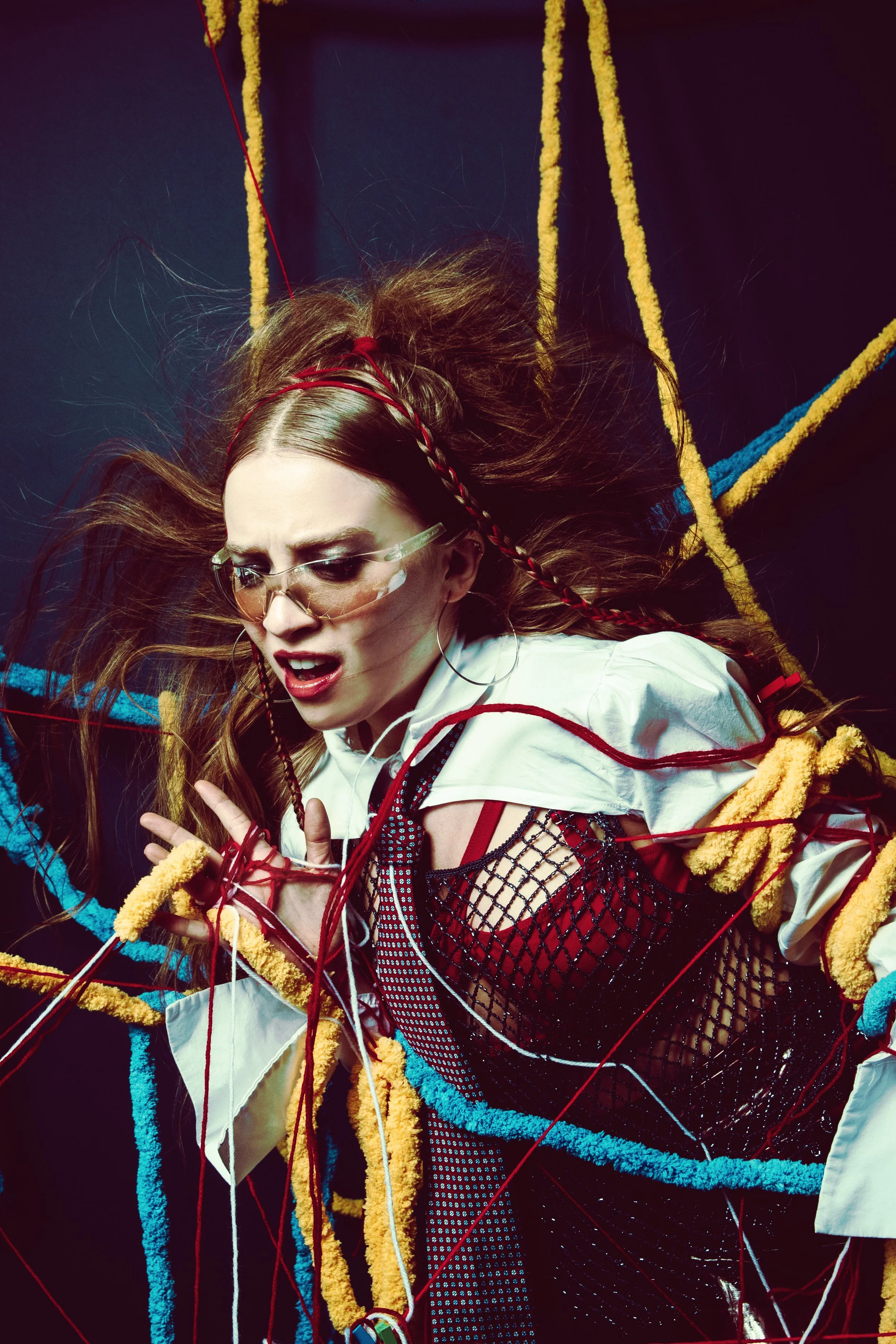
“Vulnerability isn’t oversharing — it’s choosing to show the parts that matter with intention.”
LEW: Finding that completely humbled me. I try to keep that childlike wonder alive, because everything I’m doing right now… that girl would be pissing her actual pants over. Truly.
KP: [Laughs] Right? It’s so cool.
LEW: It’s so easy to get caught up, especially when things start working — you hit one goal, and immediately your brain goes, Okay, what’s next? What’s bigger? I definitely fell into that for a while.
KP: As did I. It took a full ego death for me to move past that.
LEW: Success became this moving target: first it was “anything is success,” then it became “I need to write with these people,” then “one million streams isn’t enough, I need two million,” and suddenly I was on this hamster-wheel rat race chasing numbers that never made me feel full.
After this year — being independent, starting over, and really deeply struggling with my mental health for the first time in my life — my definition of success has shifted completely. Honestly, I could cry talking about it because I feel so much more grounded in what I want now. Success, to me, looks like being able to live comfortably, to do what I love, and to be at peace. To feel genuinely happy. Whether that means playing arenas or playing for 500 people — if I’m doing those three things, then that’s success. And if you would have asked me this question a year or two ago, I would’ve given you some big quantitative, career-achievement answer like, “A world tour” or “X amount of ticket sales.” It just feels so much less outcome-based to me now. And that shift happened because I had to let go of outcomes entirely.
At the beginning of this year, I fell into this mental prison of attaching all of my worth to external results. But the truth is that you have zero control over outcomes. You only control your actions, your effort, and your integrity. Outcomes happen when they happen. I had this breakthrough therapy session where I realized how obsessed I was with results I couldn’t control, and it honestly freed me. I haven’t felt that level of depression since the moment I understood that.
So now? Success is simple: doing what I love, living comfortably, being happy, touching people, and bringing vulnerability and human connection back into the world. That’s it. Everything else is noise.
KP: I love that you came to that. We’ve had very similar journeys in that way.
What would you tell your younger self?
LEW: I would tell her that her intuition is never wrong. And to trust that shit deeply. That feeling in your gut is right 99.99% of the time.
KP: What general advice would you lend women on life, work, or love?
LEW: My biggest piece of advice is to pay attention to whatever you’re overly obsessing about — because that’s usually the area that you actually need to step away from for a second. If I’m too obsessed with finding love, it usually means that I need to go live my life or dive into my work for a bit. If I’m too obsessed with work, then it’s a sign I need to let myself fall in love or at least open the door to being moved by something outside of my career. And if I’m too obsessed with living life… well, actually, I don’t think you ever really can be.
I think balance doesn’t look like holding everything equally all the time — it looks like knowing when to soften your grip on one thing so that another part of you can breathe. Women are so often told that we can only pick one lane: career or love or joy. But the truth is, you can have all of it. You don’t have to chase all of it at once. Trust that the version of you who’s meant to have something will meet it at the right time. That’s a hard one for me, but I really try to dive into that deep knowing of divine timing.
KP: I agree completely.
And lastly, what do you feel makes a provocative woman?
LEW: I think a provocative woman is one who isn’t afraid to take up space — emotionally, creatively, spiritually, or physically. Not in a loud way, necessarily, but in an unaltered way. A woman who isn’t editing herself to be more palatable is instantly provocative. It’s not about shock value or being overtly sexual; it’s about self-possession. A provocative woman knows who she is, or at least she’s willing to keep finding out. She leads with curiosity instead of apology. She can hold softness and power in the same breath. She tells the truth even when her voice shakes. She lets herself want things. She doesn’t shrink. To me, the most provocative women aren’t the ones trying to be “too much” — they’re the ones who refuse to make themselves less. And that kind of authenticity — that refusal to dilute yourself — is always going to provoke something in the world — desire, inspiration, discomfort, awakening. But that’s the point. A provocative woman is simply a woman who’s fully alive.
Photography: Whitney Otte