Few artists in contemporary performance have so singularly fused spectacle, activism, and radical self-expression as Narcissister.
Emerging from the downtown New York scene in the early 2000s, Narcissister transformed stages into spaces of playful provocation and incisive political inquiry, using her signature mask and intricate performances to interrogate norms around gender, race, sexuality, and the body, creating work that is as visually compelling as it is intellectually provocative.
Over nearly two decades, she has blurred the lines between persona and self, challenging audiences to reconsider what it means to inhabit a female body in public space. From her early roots as a dancer and visual artist to her groundbreaking film Narcissister Organ Player, her practice consistently foregrounds the personal as political — using humor, absurdity, and theatricality to confront societal expectations while amplifying marginalized voices.
Originally conceived as a kinetic installation for Brooklyn’s Pioneer Works, her recent work, Voyage Into Infinity, will transform NYU Skirball’s stage this January into a dynamic world of surreal feats, lo-fi magic, and theatrical pyrotechnics. A feminist response to Peter Fischli and David Weiss’s iconic video The Way Things Go, the performance centers female-presenting bodies as both agents and objects of fascination. With a live score by Holland Andrews, it channels Narcissister’s signature blend of humor, critique, and visual spectacle, amplifying questions around identity, beauty, and race while channeling raw energy and punk spirit.
Narcissister’s legacy extends beyond the body of work she has created to the pathways that she has opened for artists — especially women and artists of color — to assert autonomy, claim visibility, and embrace freedom in their practice. Her performances are living archives of courage, creativity, and resistance — a striking reminder that art can be both a mirror and a hammer.
KP: For those unlucky enough to have not been previously familiar with your work, can you tell us a bit about what drew you to art in the first place? And can you describe the significance of the mask? Why and when did it become a permanent fixture in your persona?
NARCISSISTER: I’ve known since I was a child that art was the path for me. It was something I was always drawn to. My earliest memories were either making art or wanting to make art — dancing, telling my babysitters that I wanted to work on crafts or art projects with them, sewing on my mother’s sewing machine that she wasn’t using herself, and climbing on top of the washing machine so I could get to my dad’s tool shelf and look through his tools. It’s just been clear to me that art was my path and a source of joy and comfort from a very early age.
As for the mask, that came much later. I’ve gone through so many different passages and evolutions as an artist. And I was wanting to do something singular and saw myself as someone who could do something singular. This just took time for me. By the time I conceived of the Narcissister project, I had had other careers as a professional dancer and then as a commercial artist. I was making my own artwork on the side and getting a little bit of a positive response, but not the level of response that the ambitious part of me was aiming to achieve. It was only when I thought of doing my artwork through an alias or persona that I felt my work really took off. And the main element of this persona was the mask — this idea that I could be this masked character, that I could pick a name for her, and that I could be and do and say something much broader than I could as myself — as Isabelle.
KP: Absolutely. I guess, given that Noir’s original name was The Provocateur, it’s always of the utmost interest to me to speak to women who are deemed “provocative” — and you very, very often are. When I was doing my research, that word came up time and time again. So I’m curious about your relationship with that term. As somebody who’s pegged as a provocateur constantly, how do you deal with being labeled controversial or provocative? And do those words still hold meaning to you so many years later?
NARCISSISTER: It’s so funny — when you say that word “provocateur,” I think of a freelance job that I had, which was directly connected to my starting the Narcissister project. I did the window displays at Agent Provocateur, which was on Mercer Street in Soho.
KP: Really?! Oh my god. Wait, that is so funny that you just said this now. As an aside for one second: when did you work there?
NARCISSISTER: I mean, this was right around the time when I was starting Narcissister. So it would have been from around 2004 to 2007.
KP: That is so funny for multiple reasons.
I developed POTS from Lyme disease back in 2018 and just went on Atenolol this year, which has changed my life. I regret not starting it years ago, but I’ve also gained about 30 pounds from it. Granted, I was super underweight from being sick, so the weight gain was very welcomed, but now I’m heavier nonetheless.
Anyway, to go back to AP — I used to be a big client of theirs at the Mercer Street store and ended up working with them a few times, so I have a huge Agent Provocateur collection — huge. Literally hundreds of pieces.
Just last night I said, “You know what? I don’t think any of these fucking bras are going to fit me anymore. The thongs will fit, everything else is going to be okay, but there’s no way that those bras will fit me.” I put one on last night and immediately ripped a seam in the back. [Laughs] I came to the sudden realization that I just lost my entire Agent Provocateur bra collection — to be honest, I’m devastated.
I used to shop at the Mercer Street location at least once a week. That’s so cool that you did that. I honestly think that you were there for their best era. That was right after the Kylie [Minogue] campaign, right? What they were doing at the time was absolutely brilliant. That’s really, really cool. I just had to fangirl out over that job for a second. That’s the perfect time in AP history.
NARCISSISTER: It was! I’m surprised the bra ripped because I have found that their bras are really good quality.
KP: They’re incredible quality. You know what it is? It’s because I can’t even fit one single tit inside of them anymore. [Laughs] That’s literally the reason — I’m just busting out of it.
NARCISSISTER: Well, somebody will be very psyched to buy your lot of Agent Provocateur bras.
KP: I know — I’ve been saying that I need to get rid of them as a lot! There’s no way that I can sell these one by one. But anyway, I’ll move on. That’s just very funny. And I really love the Mercer Street location. That’s truly an amazing job. Now we can keep going. [Laughs]
NARCISSISTER: It was such a cool job. And the women who worked there were also very cool — the vibe was sort of rockabilly. The women working there would often go to burlesque shows, and I started going with them. That’s when I got the idea for Narcissister because I have a history as a professional dancer and my visual art practice, and of course I was supporting myself doing commercial art. I was watching these burlesque shows, and I loved them, but I also observed that they had predominantly white performers, and it was still this homage to the Marilyn Monroe-type image. I felt that there was something missing in the scene. And with my skill set, I thought, I could do this. I could do burlesque, and I could expand it much further from there.
So that job at Agent Provocateur was pivotal in my starting my Narcissister project. And there was some transgressive work I saw in the burlesque scene at that time: Julie Atlas Muz, Rosewood, Tigger — people doing more body-intensive work within their burlesque routines. That was really inspiring to me. And that was the seed of my idea for my project.
And to go back to being labeled provocative, I don’t aim to make provocative work. I aim to make work that challenges conventional notions of the body — of women’s bodies, of sexuality, of shame. It’s important to me that my work lands in an interrogating place within all of that. Again, a lot of the burlesque work I was seeing was lacking for me because it wasn’t interrogating these ideas. I knew that I wanted my project to land as more of an activist project — to walk that fine line of taking on tropes and ideas, embodying them, and at the same time having a critical or revisionist lens towards them.
KP: That is so interesting to know of those origins, which I hadn’t read about. It makes perfect sense. When I was kind of in that world — more like 2012, 2013 — it was still cool, but I can’t imagine how amazing it must have been a decade earlier, especially in the downtown burlesque scene. The early 2000s were just so innovative here; I’ve always felt that way. So that’s really, really cool.
And speaking of you being labeled, your work has been described as “blazingly feminist,” but I feel that a lot of what you do resists neat categorization altogether. So how do you personally define your feminism? And in what way do you feel that your work challenges traditional or mainstream feminist narratives?
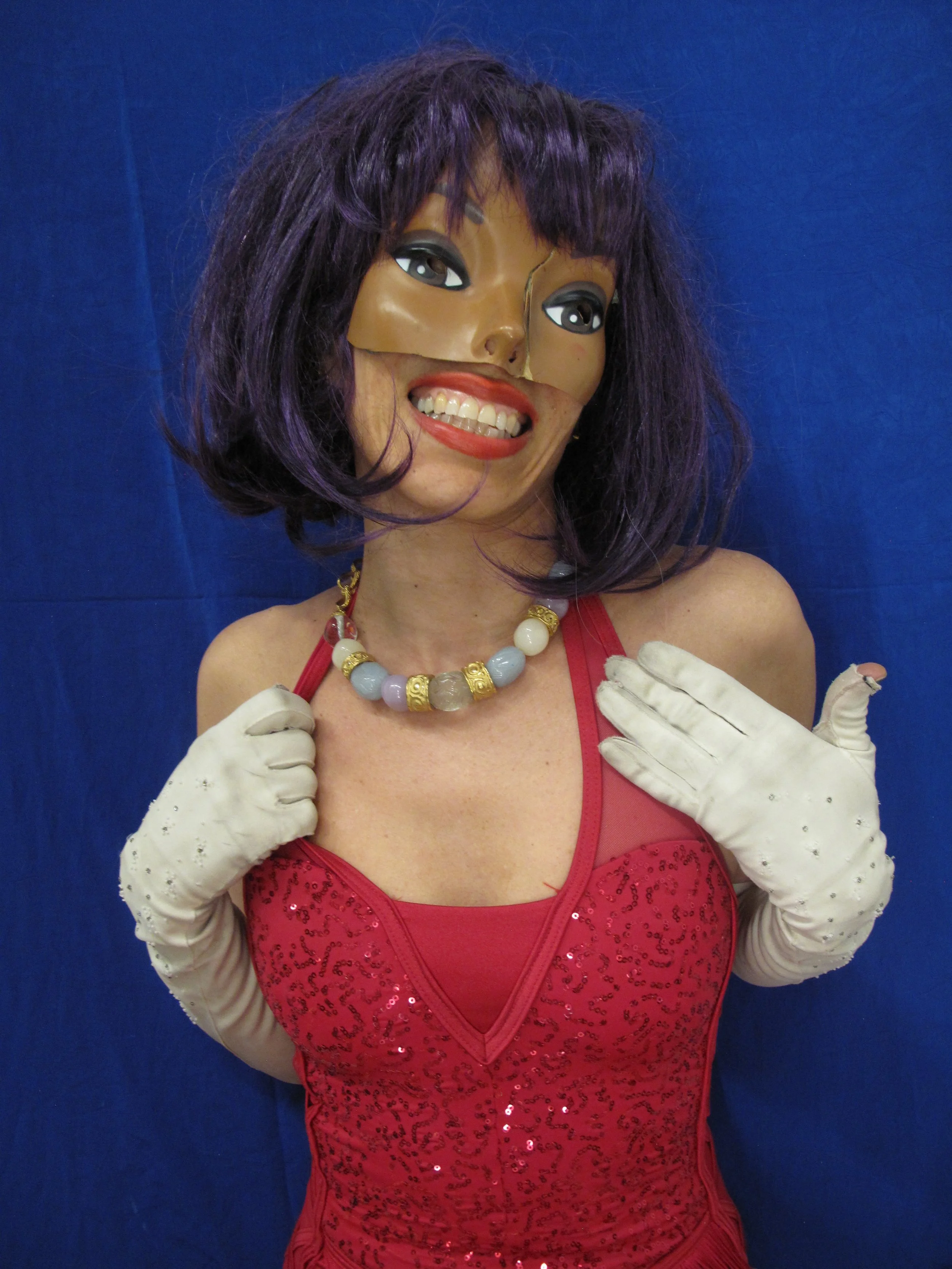
“I don’t aim to make provocative work. I aim to make work that challenges conventional notions of the body — of women’s bodies, of sexuality, of shame.”
NARCISSISTER: I mean, I guess the challenging part comes with what I just said — that I want my project to land as activist, very much in a place of challenging any conventional notions of womanhood, women’s bodies, expectations around women, and women’s sexuality. I’m very interested in that fine line. I’ve never been interested in doing something that is distinctly politically correct or careful — I’m interested in mixing signs and symbols and making things complicated, and finding my own sometimes circuitous route to making unique statements around feminism.
But what is feminism to me? Being a woman and having lived my life in a cis female body and everything that comes with that — dealing with responses, expectations, healthcare concerns — it’s so filled with pride but also rife with pain and hardship and responsibility. From my perspective, it seems that cis male bodies don’t have to deal with the same level of hardship. Maybe that’s obvious, but it’s been very real for me.
I want comfort and freedom for myself. I want my rights. I want to be heard. I want respect. I want to take up the space that is mine as a woman. I feel that’s something to champion and to fight for. And I want that for myself and for everybody. I don’t know if I’m feminist or humanist — it can be broader for me than conventional feminism. There’s so much to say about that.
KP: That could be a whole conversation on its own. But I think that’s a great way of looking at and dissecting it.
So, as someone whose work often straddles erotic classification, how do you navigate the tension between sexual objectification and sexual empowerment in your performances?
NARCISSISTER: I really trust my internal meter, and I think that comes from my life lived as a woman and all of the art and performance and writings I’ve consumed. I love to be on that razor-edge fine line. Sometimes I fall onto the side of unempowered imagery or gestures. Sometimes I fall onto the side of something that might land as politically correct or too heart-on-the-sleeve. But mostly I feel I manage to achieve that balancing act of being right on the edge. This is something that makes the work interesting to me — and I have a feeling this makes it interesting to others. I’m navigating it, but it’s a wild ride. And for me, that’s a good thing.
KP: And what do you feel your relationship is to erotic labor? And how do you see that labor represented or misunderstood in feminist and art-world circles?
NARCISSISTER: I don’t consider myself a sex worker, if this is what you mean by erotic labor. I incorporate erotic gestures within my visual art and performance art practice, and there’s a long precedent for doing that in the art and performance worlds. So I suppose I don’t know if what I’m doing is erotic labor. I think what’s relevant is that there’s a precedent for the kind of work that I do.
Maybe what’s novel about my practice is that I’m a woman of color doing it. I think there’s an extra layer of discomfort for people around that. And it gets trickier in terms of that fine line that I’m aiming to walk.
KP: Which feeds right into my next question. In your film Narcissister Organ Player, you so intimately examine both your family history and your biracial identity. How did the personal become outwardly political for you?
NARCISSISTER: I think the personal is always political. I learned this from a very young age through my parents, their rich cultural backgrounds, and family histories. The personal is political.
If anything — and maybe I diverge — but when people ask me for feedback on their work, I often feel that that’s the thing that’s missing. And I try to dig deep with them: what is it about their personal experience that they can make real in their work and understand to be political?
Even though I’m doing my work as this character Narcissister, my experience as Isabelle and the mix that’s alive in me informs the work so fully. Everything that we’ve talked about — my experience being a woman, with my body, as a woman of color, as a sexual being — it's all in the work. I stylize these details, make them full of spectacle and surrealism and abjection, and make them indirect through the Narcissister project, but they’re all there.
KP: Do you feel that the film allowed you to reveal a part of yourself or your story that performance alone could not?
NARCISSISTER: For sure. The film is a unique aspect of the Narcissister project. That was such a monumental experience in my life — my parents getting sick and dying. It was like tectonic plates shifting. I was so close with them; I admired them so much. I saw each of them deeply, their struggles and traumas, and I wanted to document what I remembered before I forgot. It felt essential and clear that I needed to do that.
As I’ve always done, I turned to art as a way of making sense of what was happening to me personally. At that moment, it was my parents having died, and it was tough. I wasn’t planning initially to put so much of myself in the film, but the film wasn’t making sense. I couldn’t tell the story of my parents without revealing more of myself.
All the interviews where you hear my voice — I originally captured those to hand over to a screenwriter who was going to write a screenplay. That didn’t work. Suddenly my voice was going to be in the film, and it was definitely a scary edge for me. Then people needed to see me in the images with my parents, and I had to find a way to show those images of me. I came up with the strategy of partially hiding my face.
I wanted to make that film work. I’m so thrilled that people around the world have gotten to know my parents through that film, and that my parents are staying alive through it. I did what was necessary to make the film strong, even if I revealed more of myself than I normally would in performance.
KP: Definitely. I think it was a really incredible medium to add to everything you’ve done.
To speak more about the mask itself — as an object, a mask is often viewed as a tool of concealment, but in your work it seems more like a mode of amplification. Do you feel the mask has allowed you to do what being unmasked would not?
NARCISSISTER: One hundred percent. The mask has made this project possible — there’s no Narcissister project without the mask. The mask amplifies her — the character Narcissister — and it hides me. In a purely visual sense, it hides me. Also, the merkin I wear is a mask for my genitals. There were things clear at the beginning that I didn’t want the audience to see: my eyes, the hair on my head, and my pubic hair. For whatever reason, those sites felt especially intimate, and I wanted to preserve them for myself. That was a personal choice that felt right to me, and I think those choices have become interesting political strategies in my work and defined the style of Narcissister.
KP: That leads into the next question perfectly. In a world that demands increasing levels of transparency — especially from women, artists of color, and anyone operating outside dominant power structures — do you feel that withholding your identity intentionally is a political act?
NARCISSISTER: I do. The ability to self-determine is political. But I want to be sure of what you mean. In what ways do you think women or women of color are asked to be transparent?
KP: I think in every way, almost. We’re held to different standards than men, particularly white men. We have to reveal more — for example, if we don’t want children, there has to be ample reason. We’re always being questioned or having to reveal ourselves in ways that men simply don’t.
NARCISSISTER: Right — to explain ourselves. Yeah. Maybe that’s another reason why it’s satisfying for me to have this stylized project where I’m performing womanhood. People project all of their expectations and beliefs onto the character, and they get reflected right back to them instead of onto me — or onto Narcissister, and her absorbing them. I feel there’s something about self-determining that’s essential and political in my work. And in embodying this character, I circumvent conventional societal expectations of what she should do or say or be. I find that liberating.
KP: And also, body art plays into that. So much of your work utilizes the body as both pen and sword — bodily insertion, reversals, hidden compartments. What role do you feel the grotesque, the extreme, or even the uncanny play in your aesthetics?
NARCISSISTER: For sure — definitely yes: grotesque, uncanny, extreme. There’s a precedent for artists doing this kind of work, especially ’70s-era feminist work with strong gestures and orifice work. The Viennese Actionists, people whose work is BDSM-adjacent — there’s so much work that inspired me and gave me permission to do this with my own body.
I don’t know many women of color who were or are doing what I would call body-intensive work. There’s a Japanese woman who famously did paintings with a paintbrush inserted in her vagina, Shigeko Kubota. That’s a rare example that I’m aware of.
KP: Do you view your body as a tool, a canvas, or a battleground?
NARCISSISTER: I guess it’s all of those things. I use it as a tool in my work — to execute, to say the message. It’s one of my clear tools and strategies along with the mask, the merkin, my art ideas, and my dance training. The body is front and center.
As a canvas — that’s what we were talking about earlier, the projections. Especially because of the mask, people project all kinds of things onto me. My body becomes a canvas in ways that I’m not always aware of.
And the battleground — that’s everything. “Your body is a battleground.” I have that t-shirt from the Barbara Kruger exhibition at the Whitney long ago, way before Narcissister. It’s real. It’s real for women, for trans people, for people of color. So many people can find realness in that idea. I don’t want to say that it’s a lifelong struggle — maybe a lifelong journey — to get our needs met in society, on personal and public levels.
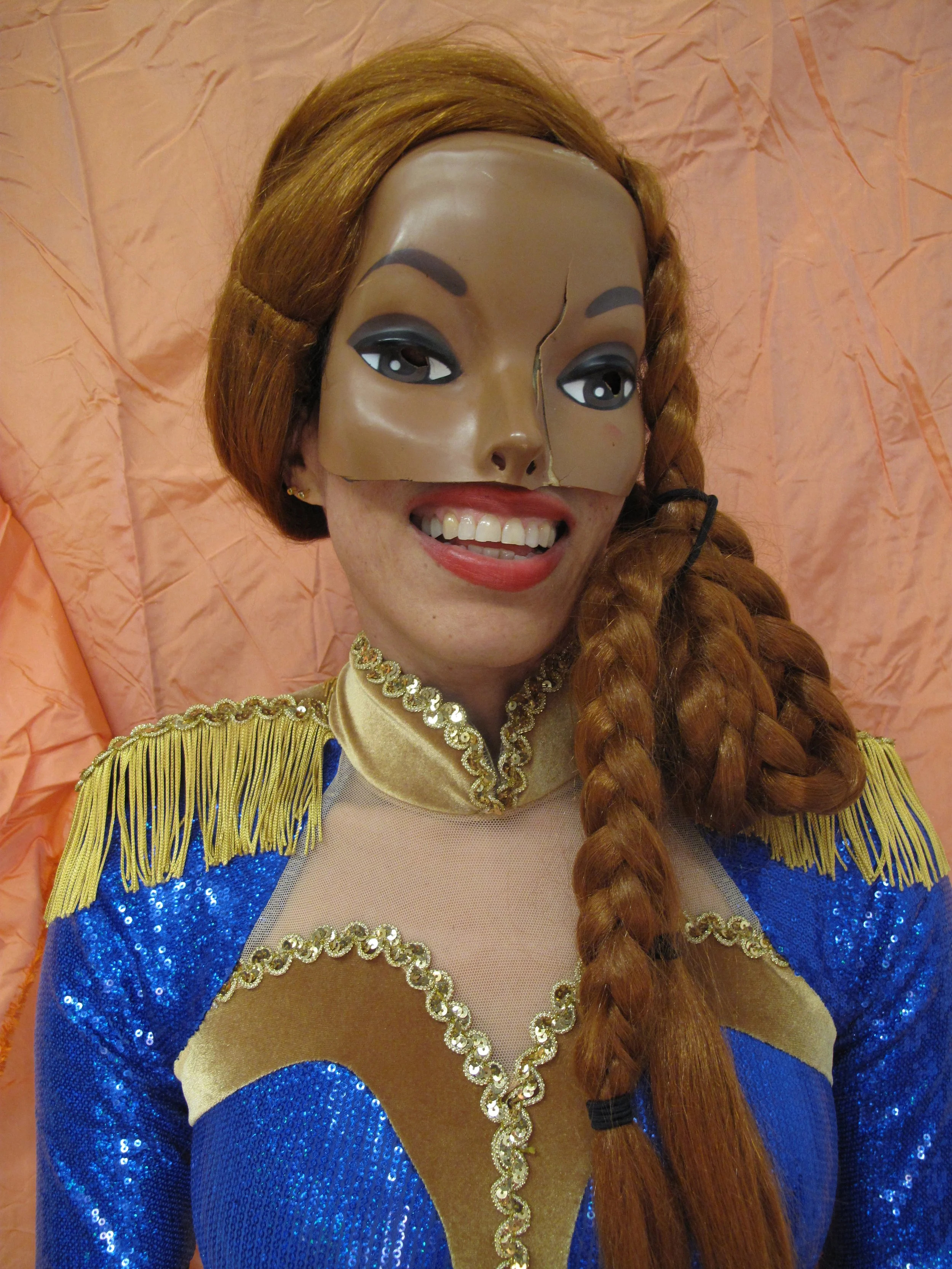
“I want comfort and freedom for myself. I want my rights. I want to be heard. I want respect. I want to take up the space that is mine as a woman. I feel that’s something to champion and fight for. And I want that for myself and for everybody.”
KP: Though we have an incredible amount of progress still to be made, one could argue that narratives of feminism and female autonomy have improved within the free press over the past decade — but you've been in the press for longer than that with the project. How do you feel media portrayals of your work have changed over time? And what do you feel they have often missed or misunderstood?
NARCISSISTER: Well, on one hand, I don’t know that I’ve gotten a lot of press. Right now, I’m preparing for a big show in January, and it seems to be this big question of how I should generate press around it. That aspect of being an artist isn’t something I love.
KP: Well, I first came across your work through press in 2008 — I was 14 at the time. I’d say by 2010, I was following you consistently. So I think you’ve done very well in that regard.
NARCISSISTER: That’s flattering. I try to follow that advice many artists give about not reading your own press. I do that when I can. Recently, I was honored with the Anonymous Was A Woman award, and Artforum ran a piece with my image as the feature photo. I was thrilled, but then I read the caption: “Narcissister, known for her neo-burlesque performances.” I feel I became known for that kind of work at first, but now I feel that I’ve clearly moved beyond it. I’ve been making sculptures, long-format performances, and collages, so seeing my work reduced to neo-burlesque was a bit dismaying.
From what I’ve seen, there aren’t many men writing about my work. One exception was Michael Kaminer for The Jewish Forward, with an article titled, “Is It Art or ‘Avant-Porn?’” I appreciated that dialogue with him, especially as he tied my work to my Sephardic Jewish heritage. But overall, I’m not sure how the portrayal of my work has shifted — I guess maybe it’s a good thing that I can’t tell. Focusing on the bigger picture and not reading my press feels healthier.
KP: I’ve always read my press. [Laughs] Hopefully I will level up to your practices regarding that one day.
Looking forward, how do you imagine the future of performance art evolving, particularly as identity politics and digital culture shift?
NARCISSISTER: The obvious thing to say is that it’s going to become much more virtual. Years ago, a well-known performance curator approached me about archiving my performances so people with VR glasses could watch them on demand. Nothing came of it, but it was an interesting dialogue.
Still, I feel that there will always be something irreplaceable about a live body in space. Being with a body in person — feeling presence — is something that virtual experiences can’t replicate. That’s true in performance, but also in life in general. Analog experiences are coming back, and I think that’s important to preserve.
KP: What do you hope that younger artists — especially women and artists of color — take away from your work?
NARCISSISTER: I aim to make work that feels good to perform, liberating, righteous, affirming, and safe. I want to create a project that I can visibly grow old in. My hope is that if it feels good to me, it will feel good to others too, and that the ways it supports me will support other people as well.
KP: What would you tell your younger self?
NARCISSISTER: It’s funny you ask this. I went through my archives recently and saw how dedicated I always was to making something with my art. Even when it wasn’t “good art,” I kept making it. Every packet of photos — even from trips away from home — had glimpses of whatever art I was working on at the time. I’d tell my younger self that I admire her dedication and conviction. I just kept working, trying to arrive at something singular, and I feel thrilled that I have. I aim to continue growing and surprising myself with what I make.
KP: That’s really beautiful.
What advice would you give women about life, work, or love?
NARCISSISTER: I have a few mantras that are very soothing: I am enough. I am safe. The world is a safe place. I trust myself and my instincts. I do my best to ask my heart what it wants rather than following my intellect.
KP: And, finally, what do you feel makes a provocative woman?
NARCISSISTER: Someone unabashedly herself, who loves herself unconditionally, no matter her stage of life or how she looks. A provocative woman is unapologetic about who she is and what she wants, feels safe speaking her truth, takes responsibility for her actions, and is self-aware. She’s unashamed, wild, and free. I’m still aspiring to be all of that myself.
KP: Well, then I think you are a very provocative woman.
Photography (in order of appearance): Narcissister, Untitled Self-Portrait Series (Color block wigs), 2025, Narcissister, Untitled Self-Portrait Series (Mom's necklace), 2025, Narcissister, Untitled Self-Portrait Series (Fringed shoulder epaulets), 2025