Sylvia Black’s music exists in the shadows — where jazz meets post-punk, storytelling meets seduction, and identity remains deliberately unresolved.
A singer, songwriter, bassist, and composer, Black’s career resists easy categorization. Her résumé spans collaborations with figures as varied as Lydia Lunch, Moby, Daphne Guinness, Télépopmusik, and The Knocks, while her pen also helped shape one of late-2000s pop’s most enduring hits, The Black Eyed Peas’ “Meet Me Halfway.” Yet despite that breadth, her work has always remained unmistakably her own: sensual, literate, emotionally incisive, and steeped in atmosphere.
Born in Alabama and shaped by an upbringing that required her to constantly “ride the line between worlds,” Black’s music reflects a lifelong negotiation with in-betweenness — cultural, emotional, and sonic. Acting was her first love, and when the rigidity of typecasting in Los Angeles proved limiting, music became a new stage on which she could fully inhabit multiplicity. Jazz, post-punk, lounge, pop, goth, and experimental forms coexist in her catalog, not as genre exercises but as languages for storytelling. Whether reimagining a classic like “I Put a Spell on You” or crafting originals that feel both cinematic and intimate, Black approaches each song as a character study, a mood, a world.
At the core of Sylvia Black’s work is an insistence on agency — artistic, personal, and spiritual. Her forthcoming album, Shadowtime, reflects this philosophy, exploring liminal spaces and unseen forces at a moment when uncertainty feels collective. A chronic songwriter by her own admission, Black measures success not by commerce but by resonance: whether a song still speaks after time has passed, whether it feels true to the soul that made it.
In a landscape increasingly defined by speed and spectacle, Sylvia Black stands apart as an artist devoted to depth, craft, and the enduring power of inhabiting one’s own voice.
KP: It’s so serendipitous and great to speak with you right now, because I actually just familiarized myself with your work a few weeks ago through Lydia Lunch, who is one of my favorite people on the planet. I actually think that she should be one of everyone’s favorite people on the planet. [Laughs]
SB: She definitely should be.
KP: She’s the best. So I guess we’ll start there, at a point of commonality. Being so multifaceted, you’ve worked with so many incredible iconic artists, including Maya Rudolph and Lydia. How did you come to first know each other, and having performed with her countless times and worked on tracks including “Walking With Fire,” what has she informed in your practice?
SB: We met when I was performing my lounge act at the Roxy Hotel in SoHo every Friday night. She had a residency when I first started, in the basement. Her story is that she was up in her room and heard somebody singing a lounge version of Psychedelic Furs’ “Sister Europe,” so she had to come down and see who was doing it. She saw me in this negligee — which wasn’t really a negligee, but some kind of see-through gown — and she wanted to meet me. We met and we clicked.
KP: True to form. I love that.
SB: I’d known of her since I was a teenager. That album, Stinkfist? The cover is burned into my brain. But I’d never seen her live, and then I went and saw her with Retrovirus, which blew my mind. It was such a great retrospective of her work, and her band was so good. She really likes jazz, noir, and film noir, so she wanted to collaborate. I was doing a jazz thing at the time, and I had this song, “Walking with Fire,” that had empty space. I thought that it would be great for her spoken word on it.
As to how she informs what I do? It’s her literary prowess and her encouragement to write stories again — that’s a huge thing for me. Also Joseph Keckler, who she’s brought into the fold, is a great storyteller. I used to write nonstop stories when I was little, and that kind of faded into journaling, then it turned into lyrics. They brought back the storytelling aspect in me. She also brought back a lot of the post-punk and punk influence, and just diving into her career, which is so rich.
KP: She’s the greatest.
To go all the way back to your origins, you’ve said that growing up biracial in Alabama meant constantly “riding the line between worlds,” which I find to be very similar to the narrative of your body of work. How did that sense of in-between identity shape your emotional vocabulary as an artist? How do you feel it shaped your identity in general?
SB: It’s isolating on one hand, but it’s also freeing. It gives you an overview, but it puts you outside of things. I feel connected to so many different things. People place expectations on me based on what I look like, and then they’re surprised to find out that I’m not that person. I feel physically many aspects, and to get it all out might take a few lifetimes. There’s really not an American genre that I’m familiar with that I wouldn’t want to learn more about or get involved in.
KP: Apart from music, acting was your first love at age five. Did the early experience of being typecast or “not fitting a type” in Los Angeles inform how you later approached reinvention and genre fluidity in your music?
SB: Definitely. I guess it gave me freedom. Acting was my passion — that’s all I ever wanted to do. When I finally got an agent in LA, the auditions were very few and far between because they weren’t looking for my type at that time at all. I was very nervous and excited when I did get opportunities, but it never panned out. It was disillusioning at a young age to realize that art and commerce can be destructive to the artist, so I found other ways to express myself. Music — putting yourself on a stage — was good for me. I enjoyed music, of course. I was a huge lover of music from a very young age.
KP: And we’re very grateful for that! To speak more to it, your songwriting résumé spans Moby, Daphne Guinness, Telepopmusik, The Knocks, and even The Black Eyed Peas, where you co-wrote the top-10 hit “Meet Me Halfway.” That shocked me when I was reading your bio. [Laughs] I love that song and I had no idea that you wrote it, so I can’t help but to ask — what was the process of writing “Meet Me Halfway” like? Did you sense its global potential while creating it? I still hear it all the time over fifteen years later; its staying power has been incredible.
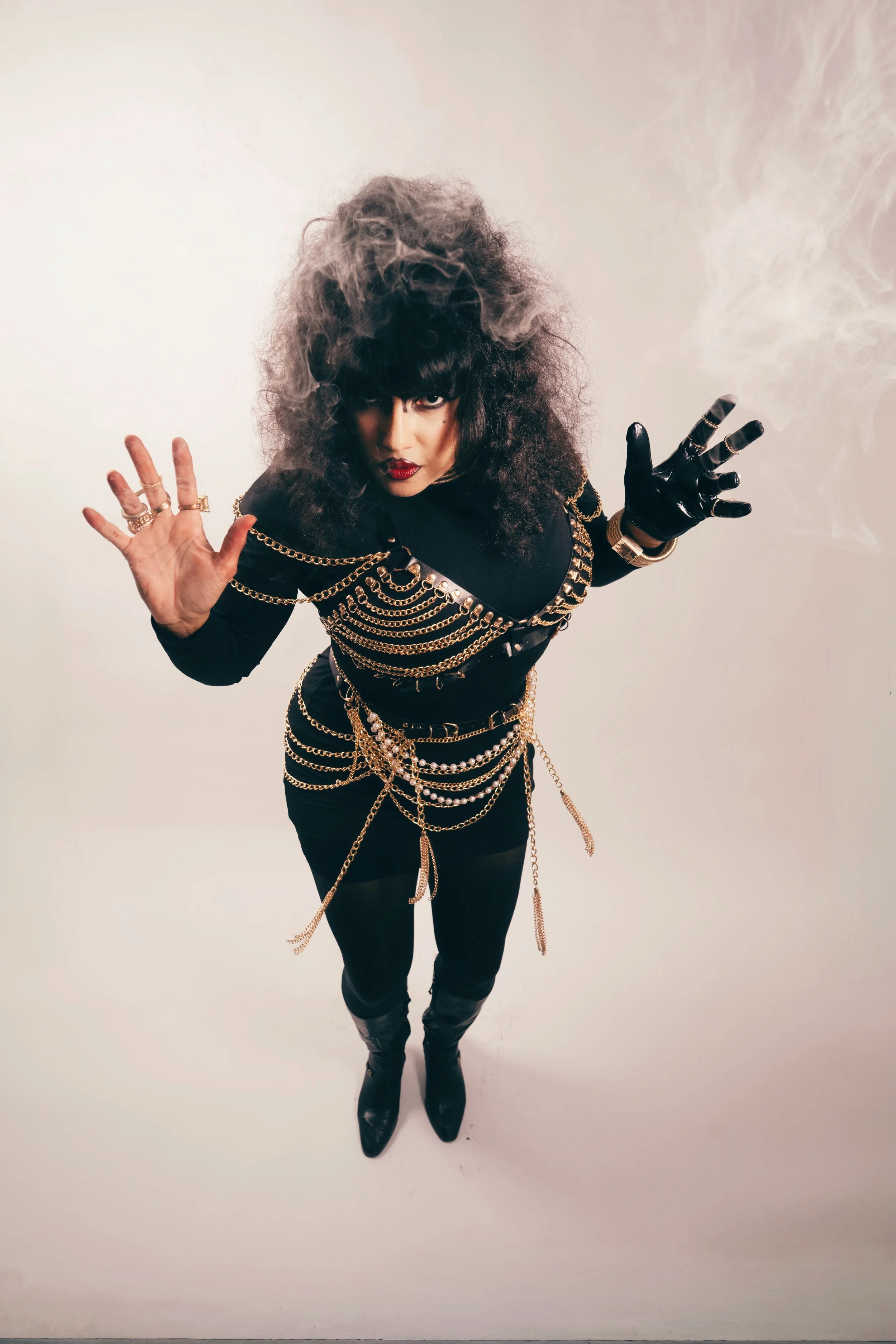
“I measure success by how my soul feels.”
SB: I had never written in the pop sphere before, so I had no idea what that world really was. I just happened to be in LA, and a friend of mine — Jules, a jewelry designer — was having lunch with a friend from high school, who happened to be Jon Batiste, the producer who works with will.i.am. She sold me to him and said, “You’ve got to take her into the studio.” I guess he liked what I had to say.
I went in, and within fifteen or twenty minutes he said, “Write to this song.” Fortunately, I had a lot of emotions about a specific topic at that time, and it just came out. He said, “Oh, this is a hit.” I thought, “That’s some LA bullshit talk.” [Laughs] But it turned out to be a hit. Beginner’s luck. I thought, “Life is easy — this is how it’s always going to be. I’ll just write hits.” That didn’t turn out to be the case, but it was a great start.
KP: It was meant to be.
I love speaking with artists who have both a home in the underground and the commercial world, because I feel that the teeth that you cut within the more cutting edge scene makes for inherently more intelligent and boundary-pushing pop culture for the public at large. But, no doubt, it’s a difficult tightrope to walk.
So as a songwriter who has achieved both underground credibility and global pop success, how do you personally measure the value of a song? And what do you define as success?
SB: Whether I really like it after a long time — which doesn’t happen often. Music is a never-ending search. There are too many influences now, especially with the internet. Everything is right there. A song can fit a time, and years later it doesn’t fit that time. I measure success by how my soul feels. Obviously, I want to survive and eat, but I’ve known of many wealthy people who are miserable. Money is not the measure. Can I finish a product, and do I like it? That’s tough enough.
KP: Your cover of “I Put a Spell on You” for the series Chilling Adventures of Sabrina became an instant classic, but you’ve said that you only do covers if you can “twist them to your will.” What governs whether a song is ready for your reinterpretation? Is there anything in particular that draws you in or that you look for?
SB: I’m attracted to the same things that other people are attracted to. I’ll often start with a male voice, because when I do it, it’s automatically different. I usually slow it down, lounge it out, bring in percussion and vibraphones — I can’t live without those. I love horns. I love arranging. If I can give it a completely new life so it doesn’t feel like karaoke, that’s the goal.
“I Put a Spell on You” is just a great song — everyone covers it. The version used for Sabrina was actually just a demo from many years back. It wasn’t even finished.
KP: Oh, wow! I didn’t know that.
SB: Yeah! They wanted it and asked for a high-res version, and I told them that we couldn’t even open it to mix it properly. You just never know what’s going to happen. It was a demo that was never meant to see the light of day. Meanwhile, the things you work hardest on, nobody cares about. [Laughs] That’s just how it goes.
KP: You release your forthcoming record, Shadowtime, on January 16th. I really love the title, of course. What can we expect from the album itself?
SB: It’s obviously a nod to Siouxsie — an icon, a queen. She can do no wrong. Initially, I thought of the word myself and then realized that it was hers. I hope people don’t think I’m trying to steal it, though — it’s more of an homage. You can’t escape her.
Shadowtime is about playing between worlds, what exists that we can’t see. It’s a tumultuous time right now. People are searching for something beyond this world, and it felt fitting for what I — and many others — are going through.
KP: I love your latest single, “Talking In Tongues,” which feels like this perfect lovechild of both goth and new wave. You said that the song is about someone who has “lost their agency by letting outward elements control them and deceive them.” What sparked that narrative — was it more a personal observation or a study in character?
SB: Initially, it started personally — repetitive behavior. The spirits they let in could be something as earthly as alcohol, and the way it changes you and brings destruction with it.
KP: When you look back at your body of work — from bass sessions to collaborations and solo albums — how do you define your legacy so far? What do you hope remains?
SB: All I have is my music. I’m still reaching for it. Maybe my legacy will be the woman who put out the most songs ever. I don’t know. I’m just a chronic songwriter.
KP: What advice would you offer to women who aspire to develop the kind of mastery and command over their instrument that you have cultivated on the bass?
SB: Learn as much as you can outside of what you think you like. Explore different genres. Learn the mathematics and the language of music so you can communicate with other musicians clearly. Pay respect to music by learning as much as you can — through school, online, or by listening outside your comfort zone.
KP: What would you tell your younger self?
SB: Stay the course. Find a way, and find it fast, because life goes quickly. If you feel passionate about something but don’t know how to go from A to B, don’t be afraid to ask for help or advice. Be a little annoying — people will see the passion and want to help. Surround yourself with good people. Learn from everyone, but eventually shake off the bad ones and keep the good.
KP: What advice would you give to women about life, work, or love?
SB: Women are so varied. Everyone has their own path. Some are born to be mothers and excel at that, while others have no desire for it. We should all be free to follow what speaks to us inside.
KP: What do you feel makes a provocative woman?
SB: A provocative woman has her own agency, marches to the beat of her own drum, has her own opinions, isn’t afraid to share them, and doesn’t back down.
Photography: Zander Fieschko