As the voice and lyrical center of deary, Dottie Cockram’s approach to music is grounded in observation: of people, of place, of society, of the quiet emotional shifts that often go unnoticed until they demand to be written about.
Raised in the English countryside, with the sea never too far away, Cockram grew up surrounded by stillness — a sensibility that continues to echo through her work, where space and restraint carry as much weight as melody.
Before deary took shape, songwriting was a solitary practice. What began as stories and poems eventually found form through a guitar picked up in her early teens, turning imagination into something tangible. That instinct — to write only when something feels real enough to hold — remains central to her process today.
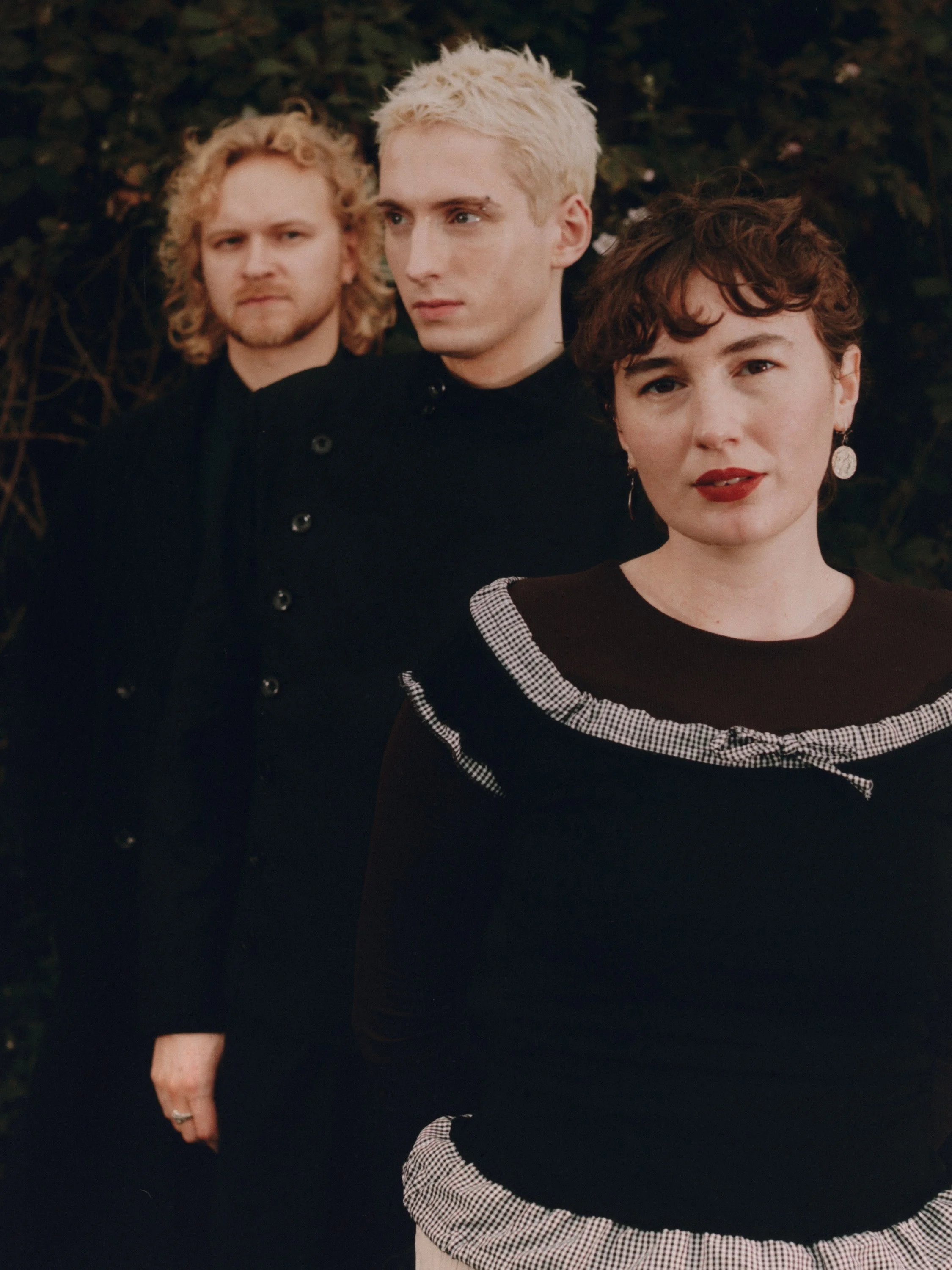
Formed through a chance connection and built on a growing creative partnership, deary has become a space where those instincts can expand. Alongside bandmates Ben and Harry, Cockram has moved from tentative beginnings toward a more assured sense of identity, one shaped by collaboration as much as introspection. Their music — often situated somewhere between dream pop and shoegaze — leans into softness without losing its edge, balancing fragility with a quiet resolve.
Offstage, Cockram’s perspective is similarly measured. She speaks openly about self-doubt, about the pressures of creating in a world that often feels unstable, and about the importance of honesty — both in music and in life. Rather than offering resolution, she leans into process: taking time, asking questions, and allowing songs to unfold at their own pace. In that way, her work with deary feels less like a fixed statement and more like an ongoing conversation — one that continues to evolve, song by song.
KP: To start at the very beginning, can you tell us a little bit about your upbringing? What first drew you toward music, and how did deary come to be?
DC: I grew up in a small town in Somerset, but I can’t pinpoint exactly what drew me to music at first. My family always listened to music but were never musicians, nor were my friends. My grandad and I would sit in his living room and listen to country records. These songs had great stories in them, and I remember imagining all the characters that were being sung about.
I really liked writing stories and poems at school. So when I started to learn guitar when I was about 12, I could turn these stories into songs. I decided to study music at college and university, playing solo along the way. In 2021, Ben sent me a message through a mutual friend saying that he liked my voice and wanted to know if I'd like to join his band.
KP: I’m very happy he did that.
Before we move on to your latest release, Birding, I love “Want You” so, so much, so selfishly I need to diverge there for just a moment. [Laughs] It’s so incredibly beautiful and sweet. Can you walk us a little bit through its writing and recording? What does it mean to you personally?
DC: I love that song too, so thank you for asking.
I wrote that song about somebody I couldn't be with. Everybody can probably relate to that; love can be cruel. I sometimes refrain from writing about love or heartbreak, as it can feel insincere, so I only want to write about these feelings when I'm really stuck in the middle of them. Music is how I've always processed complex feelings.
I believe we were looking for a slower song for our first EP, so I wrote “Want You” and sent it over to Ben. We kept it delicate and have since loved finding these moments on each of our releases.
KP: It’s so incredible. And speaking of Ben, he has said that Birding was born out of a particularly difficult period. How did that emotional landscape shape your voice on the record?
DC: As Ben says, he was struggling between Aurelia and Birding. I think we were both trying to find our feet in the next chapter of our lives. We have a great friendship and a unique one that has grown out of this band. We were making music before we were even friends! So a lot of our feelings are shared through the music we write together. I had just moved my life to a new city when we started this record, so we were both struggling to find our footing. I think this album was the only stable thing that we could come back to for a bit.
KP: The record seems to hold both hopelessness and self-compassion quite equally, which feels especially fitting in these trying times globally. Did you feel a sense of that yourself, and, if so, how did you navigate those opposing states while creating it?
DC: I definitely felt a sense of that when writing this record. It took me a long time to actually write a lot of these songs, as I got stuck thinking that it was a selfish thing to do when there is so much happening. And how do you encompass all of these feelings whilst trying to be considerate of everyone? I think I chose to write honestly in the end. We discuss anxiety, masculinity, global warming, violence against women, and political greed. I spent a long time writing the lyrics to most of these songs, ensuring that my words were intentional and meaningful. There are definitely light beams on the album too, though. I think there has to be — in music and in life!
KP: I agree!
“Seabird” and “Baby’s Breath” were the first tracks that I heard off the album, and I instantly fell in love — they’re so beautiful. Can you tell us a little about their writing and production?
DC: I wrote “Seabird” while sitting by the sea in Brighton. Our demo had this uplifting feel to it, but I knew that I wasn't ready to write like that — the world was feeling like a very dark place, and I couldn't write something fake. I was watching the seagulls ride on the wind and thinking, How do they do it? They see so much. They have existed much longer than we have, and they keep going. So I decided to ask them questions.
“Baby’s Breath” is quite unique for us. I normally write most of our lyrics, but for this one, Ben sent over his words. He was experiencing a lot of panic attacks, and this song really helped him to understand how he was feeling. We had some conversations about men's mental health and the importance of asking for help. I feel privileged to sing these words for my friend.
KP: That’s very beautiful.
As a more overarching theme, Birding weaves religious imagery seamlessly through its rich tapestry. What role does spirituality or symbolism play within the band, if any?
DC: None of us follow a religion. In the past, I did believe in a god. I’m not truly sure I still don't. These conversations weave in and out of the album. We explored our insignificance and the unjust. It’s a BIG topic.
KP: Birding also reflects on humanity’s impact on nature. How conscious were you of that theme while writing or recording? Do you see nature in your music as a mirror, an escape, or an imminent warning?
“Don’t spend too much time online. Go out and meet people. Have conversations and make things. Try and do as many of the things that you love as you can.”
DC: I’ve always seen nature as an escape. I grew up surrounded by the countryside with the sea not too far away. I love woodlands and ponds and these spaces that are so quiet and hidden. I spent a lot of my 20s in London and always felt slightly uncomfortable being in the city. I’ve definitely seen the realities of global warming and the impact that our greed has had on our world. Even since being a kid, things have changed right in front of me. It never snows anymore, drought is more frequent, and species are fading out. “Garden of Eden” is where I speak about this the most — It’s one of my favorites on the record.
KP: You said that with Birding, you’ve “grown up so much.” Ben added, “Our last EP was us trying to be deary, and this album is us being deary.” What did making Birding together solidify — or challenge — about your identity as a band?
DC: We’ve been a lot more explorative with this album. We’ve tuned into other parts of our taste that aren’t all shoegaze and dream pop. We’ve been honest with each other about song structures and ideas and pushed one another to find the best in each song. There was a point about halfway through where I think we were all doubting ourselves. We sat and had tea together and thought about the songs we had and how to bring them back to us. We decided to focus on dynamics and not have every song end in a big way — to zone in on the best bits of the songs and keep going. We’ve grown in our confidence together, and it's been a magical experience.
KP: You formed deary over your shared love of My Bloody Valentine, Cocteau Twins, and Slowdive, and you got to support the latter on stage, which must have been an absolute thrill. What was that experience like, and did it shift the way that you see your own place within that lineage? What legacy do you hope to leave behind as deary?
DC: That show is something that I will never forget. There is such a love for shoegaze and that era of bands — I really felt it in that room that night. The audience was just so grateful to be able to hear them play live again and to show the next generation how brilliant it is. We always have parents bringing their kids to our shows — it’s amazing to be a part of that. The recent resurgence of shoegaze and dream pop is so incredible to see and to be a part of.
In terms of our legacy, I don’t really think about that. The music industry is in such a vulnerable state that I’m just grateful for where we are now.
KP: I think that’s a truly great perspective to have.
Who are your influences — musical or otherwise — and how have they shaped not just your sound, but the way that you see and move through the world?
DC: I’ve always loved folk music and songs with just a guitar and voice. Adrianne Lenker is one of my favorites. Nick Drake and Joni Mitchell! As well as Grouper, who makes this gorgeous, eerie music that makes me feel so calm and nostalgic. I clearly love the Cocteau Twins, The Cure, and Jeff Buckley, too! I like songs that make you feel like spinning around or sitting still. I’m not sure how else to describe it. All of these artists are amazing lyricists too, and I'm very inspired by that. I love Adrianne Lenker’s and Nick Drake's guitar tunings — I rarely ever write in standard.
But I’m also very inspired by people and their stories. Particularly older women. I’ve worked in service for a lot of my life and had the privilege of meeting amazing older women who gleam and share their experiences and advice.
KP: Invaluable experiences, I’m sure — and very fortunate.
What advice would you lend to women who want to start making their own music — especially when navigating self-doubt, gatekeeping, or feeling like they don’t quite fit into pre-existing scenes?
DC: Find other women to play with. There are so many groups or workshops now for women in the industry to work with each other. I didn’t really have that growing up, and it definitely affected my confidence. I’m lucky to work with amazing men and women now, but before, I experienced a lot of patronizing behavior and gaslighting from men in this industry.
Don’t doubt yourself all the time — you know what you need and what you want! You’re not bossy or dramatic for just asking for something.
I would also say to create whatever you want. You don’t have to play perfectly or sing perfectly. You can make anything! As long as you love it and it makes you feel something, just make whatever you want. There will always be people out there that want to make music with you and talk to you about it.
KP: What advice would you give to women on life, work, or love?
DC: I’m still learning a lot of this. [Laughs] It sounds cringey, but you have to be yourself. I’ve spent a lot of time molding myself into something that I thought I should be, but it's so exhausting. Don’t spend too much time online. Go out and meet people. Have conversations and make things. Try and do as many of the things that you love as you can. Sometimes you have to send that first email or message to get things going.
KP: Exactly! Never fear rejection.
And finally, what do you feel makes a provocative woman?
DC: Being bold. Being fantastic.
Photography: Josh Hight