Solene on Rebellion, Reinvention, and the Future of Jazz
Solene exists just outside of time, drawing equally from the velvet haze of mid-century jazz and the cold glow of a digitized future, her sound suspended between memory and machine, intimacy and innovation.
Often credited as a pioneer of cyber jazz, her work resists easy classification, dissolving the boundaries between analog tradition and electronic experimentation. In her hands, jazz is not a fixed genre but a living language that can be stretched, fractured, and reassembled to reflect the dissonance of the present moment.
Before cyber jazz had a name, Solene was a traditional jazz vocalist, immersed in the discipline and glamour of the canon. But even then, her instincts pulled her toward the textures of hip-hop, the atmospheric pull of lo-fi, and the visual worlds of retrofuturist gaming. Rather than choosing between past and future, she began to collapse them, building a sound that felt at once intimately nostalgic and futuristically speculative.
Her latest record, Midnight Angel, deepens that tension. Set against the seductive yet predatory backdrop of Hollywood, the album traces a personal descent through illusion, excess, and self-destruction, before turning — deliberately, imperfectly — toward healing. It is both a love letter to music and a quiet indictment of the industry that surrounds it, exposing the cost of visibility in a system that often demands more than it gives.
Across her work, Solene returns to the same central questions: how to remain human in an increasingly artificial world, how to create without compromise, how to survive without losing yourself. Her answer is not resolution, but resistance — an insistence on authenticity in an era that rewards imitation.
In carving out a space for cyber jazz, she has also carved out a space for those who exist between eras, between identities, between expectations — proving that sometimes, the most radical act is simply to remain whole.
KP: You’re widely recognized as a pioneer of cyber jazz, a striking fusion of jazz tradition and digital experimentation. How did you first begin composing in this space, and what influences shaped your earliest explorations?
SOLENE: I’ve always been drawn to harmonizing juxtapositions, especially retrofuturism. I’ve felt like an old soul from a time that hasn’t happened yet, like I never really had a place in the world. Early on, I was inspired by artists who carried that same timeless and forward-thinking energy: Portishead, Björk, The Pharcyde, A Tribe Called Quest, and Erykah Badu. At the same time, games like Fallout and BioShock deepened my love of retrofuturism, as well as classic jazz vocalists like Ella Fitzgerald, Billie Holiday, Frank Sinatra, Nat King Cole, and Bobby Darin. Seeing so many different combinations of old and new helped me find my voice. Cyber jazz grew out of wanting to create my own place in the world where my specific combination of past and future could coexist and to give others between eras a place to belong as well.
KP: To speak of your origins, you started your career as a traditional jazz vocalist. Was there a specific moment when you realized that tradition alone could no longer contain your artistic voice?
SOLENE: I’ve always loved traditional jazz and the glamour of that era, but I was just as drawn to old-school hip-hop. At a certain point, I realized that staying in one style meant leaving out a huge part of myself. The rise of lo-fi — especially how it blended hip-hop with anime and gaming visuals — opened a door for me. Those worlds had already influenced my aesthetics, so combining them with jazz just felt right. Once I stopped trying to fit into a single box, my music became a more accurate reflection of myself, and that’s when my voice fully emerged.
KP: You’ve said that jazz has always resisted a single definition. Do you think that refusal to be neatly defined is precisely what allows the genre to remain timeless?
SOLENE: Absolutely. Jazz is timeless because it’s always evolving. It has never been fixed to one sound or era, which allows it to absorb new instruments, technologies, sounds, and cultural movements as they emerge. That allows jazz to exist forever — speaking to the current times while still honoring the past.
KP: Jazz has also long been rooted in live, ephemeral performance. How do you reconcile that emblematic impermanence with the permanence and infinite reproducibility of digital sound?
SOLENE: I was searching for a way to bring a live jazz element into my music, and that’s where J. Rawls came in. He had the brilliant idea of bringing his group, The Liquid Crystal Project, into the studio to play live jazz over the beats for Midnight Angel. We created a fusion of loops, structure, and improvisational spontaneity, and that built the bridge between digital production and impermanent analog.
KP: Historically, jazz has functioned as a form of defiance and resistance. In what ways do you feel cyber jazz carries that political or social charge today?
SOLENE: Cyber jazz pushes back against the state of the world we’re living in. The genre of cyberpunk is political, and that aligns closely with jazz’s spirit of rebellion. Lyrically, my songs often speak to this, but even the ones that encourage individuality carry a social charge. They push against the growing pressure to conform, to consume, and to outsource our identities to corporations so we’re easier to control and profit off of.
KP: To speak more on cyberpunk, its literature has played a critical role in your work. What parallels do you see between cyberpunk’s dystopian worlds and the realities that contemporary artists are navigating today?
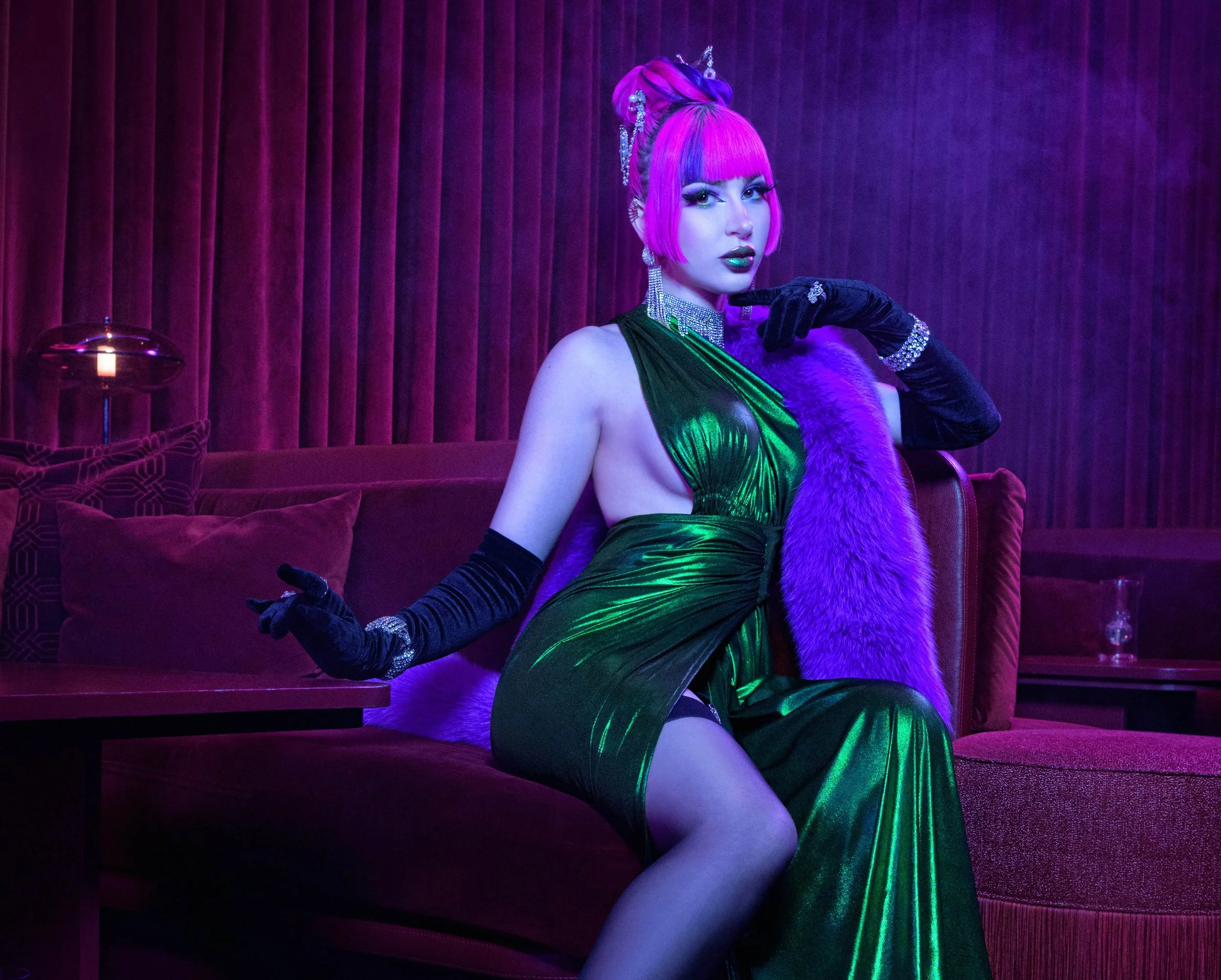
“Know where you stand in the world, speak your mind, and do not let societal expectations dictate your choices.”
SOLENE: Well, while technology (in the form of streaming platforms) finally allows us the opportunity to bypass labels, it also bottlenecks visibility, pays pennies, and places us at the mercy of algorithms shaped by corporate interests. We’ve got streaming platforms paying producers tiny fees to make tracks that they then release under fake artist names on their playlists so they can keep the streaming money... We’ve got AI music trained on the work of starving artists flooding the platforms... Every day I see the dystopia becoming less speculative and more imminent.
KP: Your latest record, Midnight Angel, presents Hollywood as both a dream factory and a predatory ecosystem. When did you first begin to understand the cost of visibility in its environment, and how have those realizations shaped your career?
SOLENE: I understood the cost early on. I’d say that Hollywood’s reputation precedes it. Like a lot of young people, I went in believing that I might be the exception — I wasn’t. I encountered my share of predatory gatekeepers, and I realized quickly that path wasn’t for me. Instead, I chose to keep my soul, dignity, and sense of freedom by playing the long game. If it worked, great. If it didn’t, I could still sleep at night knowing that I stayed true to myself. Over time I’ve seen the power of authenticity, and my career is a reflection of that.
KP: Addiction and self-destruction appear on the album as both temptation and consequence. How did you approach portraying those forces honestly without romanticizing them?
SOLENE: By being honest and not holding anything back. I don’t try to sugarcoat my struggles when I write about them. Over the course of Midnight Angel I’m watching myself spiral, and it’s not as glamorous as it feels in the moment. It’s ugly, raw, and imperfect, and that’s exactly why it doesn’t romanticize self-destruction.
KP: Similarly, survival is a recurring theme throughout the record. What did survival look like for you before healing entered the picture — and did the act of recording ever become part of that healing process?
SOLENE: Music saves me every day. Before healing, I survived by searching for hope in a city of disappointments. It wasn’t easy. I had only my belief in myself to keep me going, and it’s difficult to create music in survival mode. I think a lot of artists know that feeling. When we can’t create, something in us starts to wither, yet creating is the cure. Writing forced me to face the experiences and emotions that I had buried or allowed to quietly control me in destructive ways. Giving them a voice helped me process them instead of being ruled by them.
KP: Healing on Midnight Angel isn’t portrayed as linear or triumphant, but as something repetitive and deliberate. Why was it important for you to frame recovery as a choice that was repeatedly made?
SOLENE: Recovery has to be a choice that you make over and over again. When you’re at your lowest, you don’t always have the tools that you need right away, even if the desire to heal is there. Temptation is always going to be drawn to vulnerability. What mattered to me was showing that each decision to try again builds your willpower, and that’s how you give yourself the chance you need to grow.
KP: The album reads as both a love letter to music and a sharp indictment of the industry that surrounds it. How do you reconcile a deep love for art with a growing distrust of the systems that support it?
SOLENE: I’m going to make art regardless because I love it. Words are my weapon, and I use them to shine light on the darker parts of the industry as a warning to others. I don’t want them to make the same mistakes I did. Having mentors like Talib Kweli, who has long used his music as an expression of resistance, and Conductor Williams, who proves that you can succeed without conforming, reminds me that there’s more than one way to exist inside this system without being consumed by it.
KP: What would you tell your younger self?
SOLENE: Do not change for anyone. What your soul is telling you to create is correct — that’s why it’s coming from your soul. Trust yourself, even when you feel misunderstood or ahead of your time. The world will catch up eventually.
KP: What advice would you lend to women on life, work, or love?
SOLENE: Find purpose in yourself; it will fill the void that you may end up trying to fill with toxic relationships that ultimately hold you back. Never apologize for what you have to do to survive in a world that’s systematically stacked against us. And never ever take a man at his word before he’s proven to you that it’s worth believing.
KP: What do you feel makes a provocative woman?
SOLENE: Intelligence, depth, and self-assurance. She does not have to turn the world on its head or perform some great feat. A woman that knows what she wants and doesn’t settle can move mountains. Know where you stand in the world, speak your mind, and do not let societal expectations dictate your choices. We can all be provocative when we choose to live our lives without limitations or apology.
Photography: Radiant Inc