Few young bands have arrived with the undeniable force of HotWax. Formed in Hastings by childhood friends Tallulah Sim-Savage and Lola Sam alongside drummer Alfie Sayers, the trio has quickly established itself as one of the most compelling voices in contemporary rock, channeling decades of influence into something that’s fiercely alive.
Raised on a diet of '60s girl groups, garage rock, punk, grunge, and the fearless experimentation of artists like Karen O, Nick Allbrook, and Ty Segall, HotWax's music is equal parts reverence and reinvention. Their sound absorbs the raw physicality of rock's past while refusing nostalgia, colliding distorted guitars, unrelenting rhythm, and melodic immediacy into songs that feel urgent, instinctive, and undeniably alive.
That same spirit extends beyond the music itself. Since their earliest days, HotWax has resisted the reductive expectations so often placed upon young women in rock, choosing authenticity over performance and creative freedom over conformity. Their work embraces contradiction — equal parts abrasive and vulnerable, chaotic and deeply human — while remaining rooted in the belief that music is, above all, an act of expression rather than expectation.
Following the release of their acclaimed debut album Hot Shock, the band continues to push beyond easy categorization, carrying forward rock's most uncompromising traditions while proving that its future belongs not to imitation, but to fearless reinvention.
KP: You guys really fucking rock. I don’t know another way of putting that! [Laughs] I’m so into your sound and your music, and I’m 32, so it’s incredibly refreshing to see younger women going so hard and still being so real. Thank you for keeping that alive.
For those who don’t already know, what first got you into music, and who were your earliest influences?
TSS: Growing up in musical families and in towns that encouraged both music and art is what got us all into music to start with. For me, when I first started to get into music that wasn’t pop-focused, it was artists like Aretha Franklin, ‘60s girl groups, and folk bands like The Staves and First Aid Kit. Then I discovered bands like Blondie, the Yeah Yeah Yeahs, and Hole.
Then at the age of about 14, both Lola and I fell madly in love with the band Pond and all of Nick Allbrook’s musical endeavors and then Ty Segall and all of his. This was very influential to HotWax.
KP: You guys have great taste.
Many have labeled you a “girl band” through the years, and I read a lot about your relationship to the term. I recently spoke with Jennifer Finch from L7 about that same topic — it’s astounding how we can still have these same conversations in rock over 30 years later.
TSS: [Laughs] It used to infuriate us so much. I remember one of the first shows we did in our previous band, The Kiffs. It was a summer fair type of show, and the man introducing the bands on stage asked us for our favorite feminist quote. I barely even knew what a feminist was back then! We were so angry that we weren't seen as a “normal” band — that our gender was such a massive thing.
KP: Of course! Well, I’m wondering how your feelings about being labeled a “girl band” have changed over time, if at all. Is it something that you now have learned to embrace, or do you still look to quickly expand past it?
TSS: I think now that we’re a bit older and less stubborn, we’re honored to be females in this industry. It’s a very empowering thing. I feel proud to be a “girl band,” even if Alfie is a boy. I would say this embracing of it happened only after working with and alongside so many incredible women.
KP: That makes a ton of sense! As a woman myself, I see both sides. There’s this natural push and pull nature to it, isn’t there?
To move on to your music, the first track that I ever heard of yours was “Drop,” and it made me stop everything that I was doing to see who performed it. As I mentioned earlier, I was even more thrilled to see how young you were — it truly feels like you’re carrying the torch for this higher-octane brand of rock in a way that feels so authentic.
Needless to say, it’s still one of my favorites of yours. Would you mind telling us a little bit about its writing, recording, and production?
TSS: That is so lovely to hear, wow! We wrote “Drop” at the same time that we wrote the A Thousand Times EP, but it just didn't make it, so it ended up on Invite Me Kindly. This was at a time when our writing was totally naive — we didn't really overthink or overcomplicate things because we were a band just playing for ourselves, rehearsing every week, and writing lyrics about falling out with your best friend. The sound and the songwriting from this time have that special essence, kind of childlike, which I suppose makes them more true. We worked on this song with Ben Beetham, a producer who did our first two EPs.
KP: It was the right choice — they’re flawless!
Being a native New Yorker, the Yeah Yeah Yeahs are my favorite band of all time, and they soundtracked much of my early baby trouble days on the Lower East Side here in New York City. [Laughs]
You’ve said that one of your biggest inspirations is Karen O, so we connect there very deeply. I can’t help but to put you on the spot and ask what your favorite album or track is.
Before you answer though — I’ve had time to think about it and, honestly, I don’t think I have one. I saw them perform one time here at Webster Hall right after Mosquito came out, and it was one of the best nights of my life. I just love them so, so fucking much.
As to a favorite album, it’s a coin toss among Fever To Tell, Show Your Bones, and It’s Blitz! for me, although I also love their earlier releases like IS IS. I’m obsessed with Karen’s album with Danger Mouse, too.
Wait… I’m really thinking about it... Maybe my favorite, more personally touching track is “Soft Shock,” but I think “Dragon Queen,” “Phenomena,” “Gold Lion,” “Date With The Night,” and “Black Tongue” are so sexy. Their music is just so fucking hot, you know? [Laughs]
Okay, I could talk about this forever! I’m going to shut up now. [Laughs] Your turn! I won’t judge.
TSS: Oh my god! I love you. I so feel you on all of this, and that’s the thing with Karen’s voice, right? She exudes so much power and such sexiness but is also so vulnerable and deeply emotional.
Fever To Tell has to be my favorite. My mum used to put that CD on in the car when I was a kid — it used to make me feel kind of uncomfortable in this strange way, but I loved it so much.
KP: What?! You have a really fucking cool mom! [Laughs]
TSS: The freedom in Karen’s voice and Brian’s drumming and the high janky strings played on Nick’s guitar make me feel so excited. There are moments from all of the albums that I absolutely love! I adore “Zero” from It’s Blitz! and the IS IS EP.
I’ve seen them live twice and met them at All Points East the second time that I saw them. She shouted us out on stage; it was one of the best days of my life.
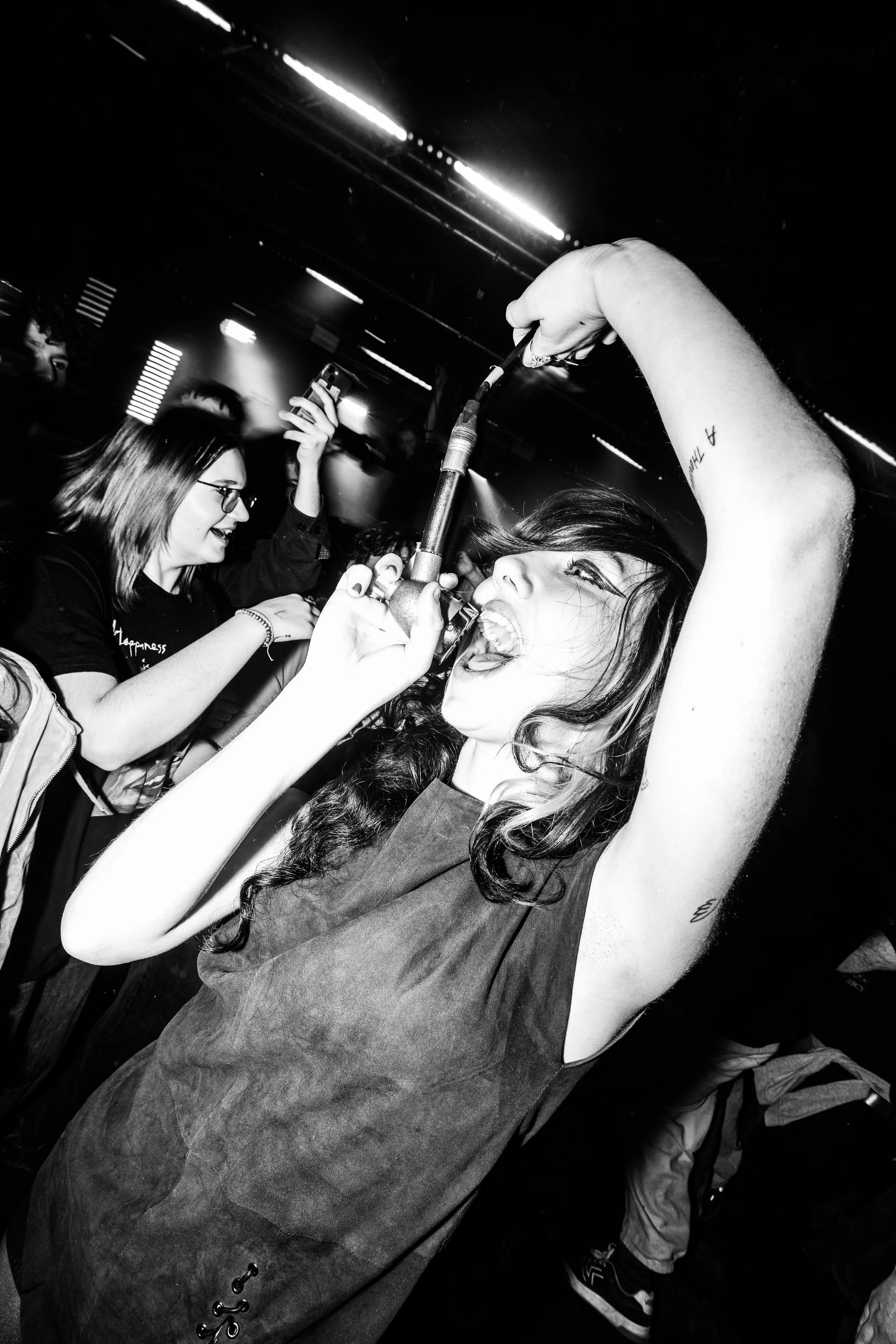
“I think now that we are a bit older and less stubborn, we are honored to be females in this industry. It is a very empowering thing. I feel proud to be a 'girl band.'”
KP: Oh okay, showoff! [Laughs] I’m so not shocked to hear that, though. She’s got taste! That’s the absolute coolest.
Your live shows have often been described as explosive. Needless to say, live performance has played a critical role in the transmission and history of rock. How do you translate the rawness of your recordings into a physical space?
TSS: I would almost say it’s been the other way around, especially for the recording process of Hot Shock. We wanted our debut record to have a live, energetic, passionate, and raw feeling — almost like Fever to Tell! We experimented in the studio with different ways of encapsulating this energy. We threw a gig/party in one of the rooms at RAK and invited all of our friends down to that. We played most of the record in the room together and then overdubbed extras.
Recording the album took ten days, which amounted to about a song a day. It was a fast process, and we dialed in most of the sounds in the moment. This quickness added to the live sound as we didn’t have time to over-refine anything. It added to that naive, youthful, teenage feeling.
KP: What’s your favorite concert of another artist that you’ve ever attended?
TSS: I think I would again have to say the Yeah Yeah Yeahs at All Points East, really because it was such a special moment for us. It was one of our biggest shows that we had done at the time, and to be opening the stage for my favorite band — and then watching them with Lola and our managers — was so memorable and emotional.
KP: Truly incredible.
To circle back to your experience as a predominantly female band, how do you navigate the expectations placed on young women in rock spaces that have historically been male-dominated?
TSS: There are so many extra expectations placed on women in the industry. It feels like you have to go that extra mile and work extra hard just to get seen and respected. I see this in every role in this industry — managers, tour managers, artists, producers, and so on. We have always really just tried to be authentic and to stand our ground in these spaces. Sometimes it feels like an uphill struggle, but if we conform or stay quiet, then things won’t change.
KP: Exactly right.
Critics often reach for references including Hole or The White Stripes when speaking of your work, but your music feels less like revival and more like reclamation, which is an even greater compliment to me.
Do those constant comparisons feel reductive, or do you see them as part of a lineage that you’re consciously engaging with?
TSS: That is a great compliment. Thank you. That definitely feels more accurate to me. We love those bands and have a lot of older influences, but I believe that we are inspired by so many different genres and players. We absorb everything that life throws at us and throw it all up into the sound of HotWax.
Of course it’s easy for critics to listen to one of our songs, hear a woman with a grunge voice, and compare it to Hole. It’s funny — it’s definitely something that happens to women-fronted bands all the time!
KP: It definitely is.
To shift to your records, you released your latest album, Hot Shock, last year. Do you have a favorite track off it? If so, why?
TSS: “Chip My Teeth For You” and “Pharmacy” are my favorites. “Chip My Teeth For You” really speaks for the album, I would say. Hot Shock is about the chaotic, self-destructive, love-filled, and love-fueled couple of years that we had coming out of being teenagers and entering our 20s. I would chip my teeth and get into scrapes for the band or for Lola or for the people I love, and that’s sort of what that song is about. It was also the first one that we recorded with Steph and Catherine — the feeling I had in the studio that day was the best that I had ever had in a studio! I was so used to feeling stressed and sort of unsatisfied, but the sound we made on that track just felt so right.
“Pharmacy” is special to me, too. It feels like a safe song — it’s like a warm blanket at the end of all this chaos.
KP: You’ve often spoken about the importance of keeping grassroots music venues alive, something that is becoming increasingly more important as the entire industry has become perilously more corporatized.
What have been some of the grassroots venues that are closest to your heart, and how can we — as both musicians and listeners — make efforts to keep them relevant?
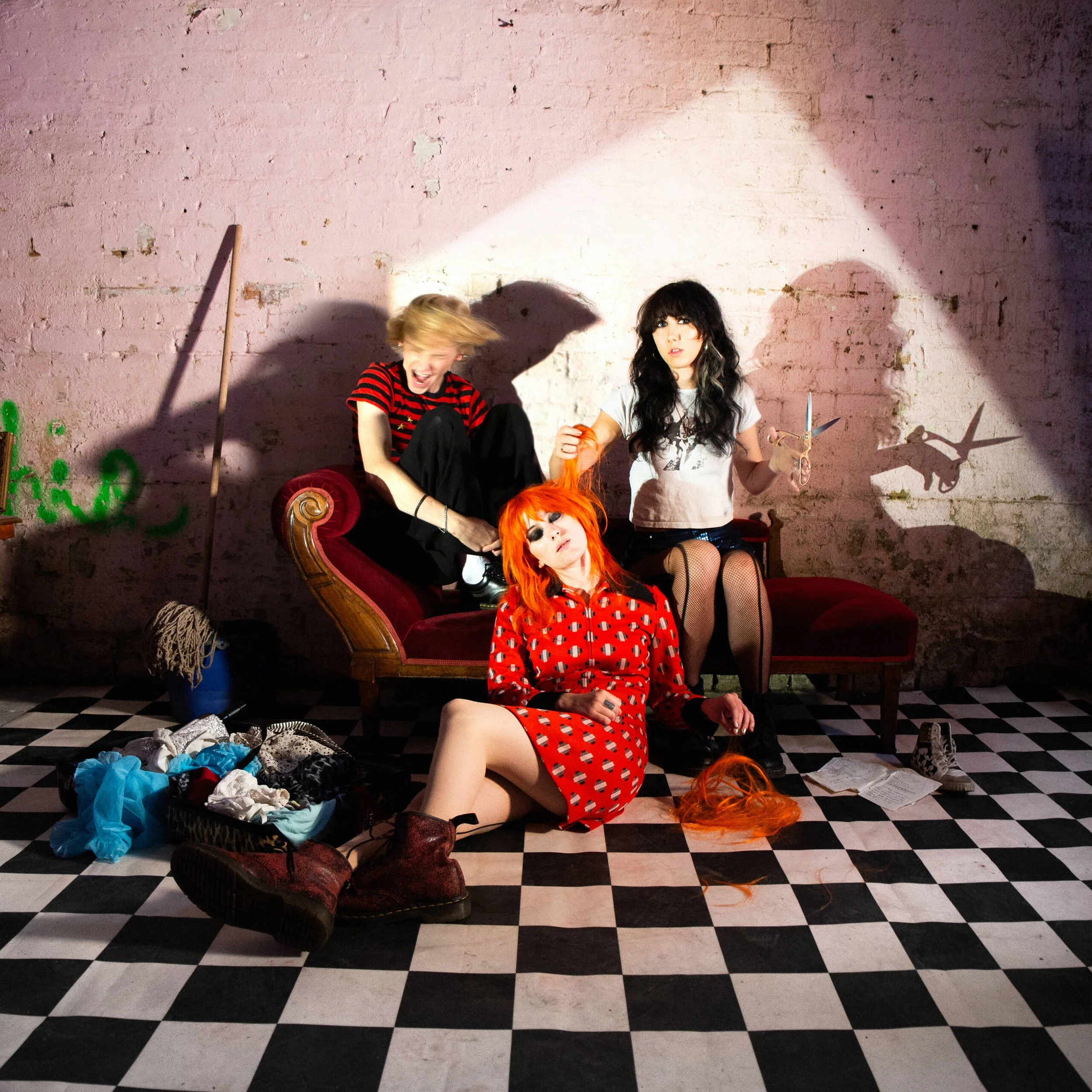
“There are so many extra expectations placed on women in the industry. It feels like you have to go that extra mile and work extra hard just to get seen and respected... Sometimes it feels like an uphill struggle, but if we conform or stay quiet, then things won’t change.”
TSS: The Green Door Store in Brighton is a place where we’ve spent a lot of time. It is a really special place to me and probably the venue that I would go to the most locally.
But after years of touring all around these grassroots venues, they all have a special place in my heart. We have incredible memories and there are absolutely insane efforts being put into them by their owners, staff, and communities.
To keep them relevant, we need to attend the shows, keep playing them, and keep playing the smaller areas — not just the major cities. We need to keep the scene healthy. It is so important for both our mental health and well-being.
It’s our right to have these spaces available for art, music, and expression — especially for the young people who are already going through a weird time with social media and phones dulling human connection.
KP: I read that you both dealt with rather intense physical bullying at school, as did I. I think only the coolest kids ever do.
How did you deal with that, and do you feel like it almost prepared you for public scrutiny?
I went through so much abuse during grammar school that when high school came and I became accidentally very successful almost overnight, my armor was already so strong that nothing anyone wrote ever hurt me. It’s a nice, unexpected tradeoff, right? It almost makes it worth it. [Laughs]
TSS: Oh my god, yes! All throughout primary school and secondary school I had a really hard time. I never had many friends and was very shy and anxious — I never fit in. School was a terrifying place to be. I hated it so much, but I’m so glad I went through all of that.
It hit me a few years after leaving how much of an effect it actually had on me. I am definitely a bit traumatized by it — my self-worth and confidence were definitely knocked.
However, It was kind of good to go through it. It was a life experience learning to deal with all sorts of people and being able to take things on the chin.
KP: Absolutely! Bittersweet, right?
What would you tell young women who are currently going through similar torment?
TSS: I would say that if you’re in school, just know that it feels so all-consuming in the moment and like it is never going to be over, but before you know it, it’s a distant memory. It’s so cliquey, but all of those cliques evaporate into nothing as soon as you leave. When I left, I gained so much confidence and felt so much strength. Try to find at least one person to have by your side — even if they are at another school, you can have someone to bond with.
KP: On the topic of advice, what would you tell women who feel the pull to start a band but are still navigating doubt, space, or permission?
TSS: I would say to get together with a few people who want to create with you, find a date, and turn up with no expectations. Just express yourself. Try not to put any restrictions or rules on what you’re doing and try not to box yourself into anything. Even if it’s just creating music for a hobby or your mental health, it will be a positive experience and outlet.
KP: What did forming a band teach you about confidence, and what would you tell women who are still struggling to find theirs?
TSS: In my previous band, The Kiffs — the one that Lola and I started — I was just playing guitar. Back then I was definitely lacking a lot of confidence, but I always had this fantasy about fronting a three-piece band with Lola.
When our singer stepped down, I made that happen. For so long I would hide behind vocal effect pedals or just write instrumental songs, but as I pushed myself further it just became easier to perform.
It feels so empowering to have your own band, to be your own boss, to run your own business, and to have creative freedom.
KP: What do you feel makes a provocative woman?
TSS: A woman who is passionate — one who speaks her mind and is not afraid. If you are a naturally shy or quiet woman, then I think it is provocative to go with your gut. Do what you believe in.
Photography (in order of appearance): Jude Harrison, Jude Harrison, Louise Mason